
5 Signs Your AI Agent Is Moving Work, Not Solving the Problem
Task completion looks productive. Problem resolution changes the outcome.

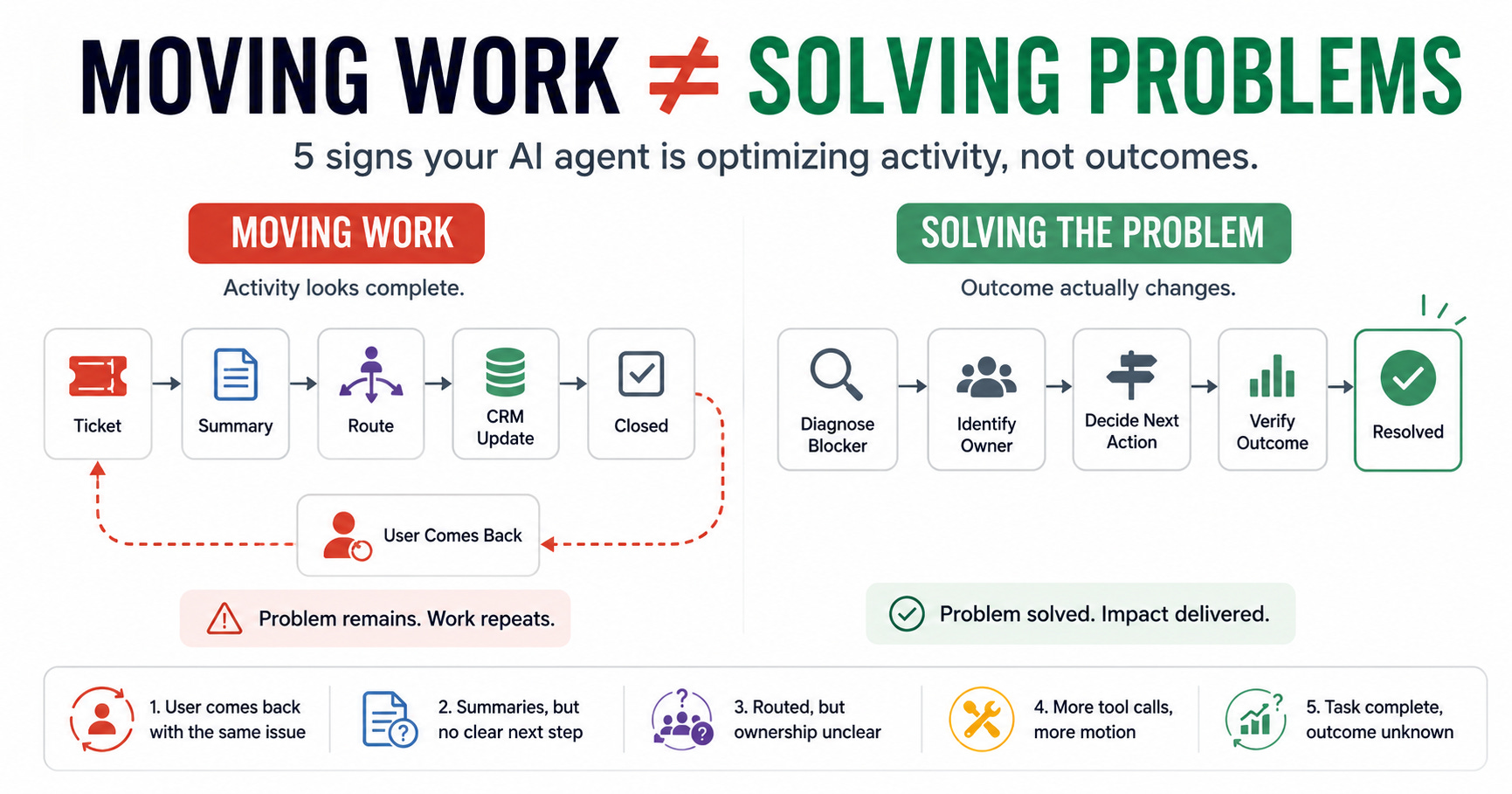
Your AI agent can close the ticket.
It can update the CRM.
Summarize the thread.
Route the escalation.
Draft the response.
Trigger the next workflow.
Mark the task complete.
And still, nothing important may have changed.
The customer is still blocked.
The team is still confused.
The owner is still unclear.
The risk is still unresolved.
The same issue will show up again tomorrow with a different ticket ID.
That is the difference between moving work and solving work.
Moving work creates activity.
Solving work changes the outcome.
A lot of agentic AI demos are built around movement. Respond faster. Classify faster. Summarize faster. Route faster. Draft faster. Update faster.
All of that can be useful.
But speed is not the same as resolution.
A faster unresolved problem is still unresolved.
That is the trap.
The agent looks productive because the workflow is moving. The dashboard improves. The queue shrinks. The SLA turns green.
But the real question is not:
Did the agent complete the task?
The real question is:
Did the problem actually get smaller?
That is where many enterprise AI agents fail.
They move the work forward without resolving the reason the work existed in the first place.
The ticket disappears. The user does not.
The easiest place to see this is support.
The agent reads the ticket, classifies the issue, finds a policy, drafts a response, updates the status, and marks the case resolved.
From the system’s point of view, the work is done.
From the user’s point of view, nothing may be solved.
They come back with the same blocker.
The same confusion.
The same unresolved pain.
This happens when the agent is optimized for ticket closure instead of user resolution.
A ticket is an internal unit of work.
A problem is the user’s lived reality.
Those are not the same thing.
If the user still cannot move forward, the agent did not solve the problem. It only moved the work out of the queue.
That means the success metric should not be “case closed.”
It should be something closer to:
Did the user become unblocked?
This changes the agent design.
Now the system has to care about repeat contact, unresolved intent, escalation quality, and whether the final answer actually helped.
The best signal is not closure.
It is non-return.
The summary is accurate. The decision is still unclear.
Another common failure mode is the summary agent.
The agent reads a long thread.
It extracts the key points.
It lists the participants.
It explains what happened.
It produces a clean, accurate summary.
Everyone agrees the summary is good.
Then someone asks:
So what should we do?
That is the moment you realize the agent reduced reading time, but not decision friction.
Summarization is not decision support.
In enterprise work, the hard part is often not that nobody can read the context. The hard part is that nobody knows which part of the context matters.
A useful agent should not only compress information.
It should expose the decision.
What changed?
What is blocked?
What is the risk?
What are the options?
What tradeoff needs a human?
What is the next safest action?
If the output is accurate but the team is still stuck, the agent created a document.
Not resolution.
The better question is not:
Did the agent summarize the thread?
It is:
Did the agent make the next decision easier?
That is the difference between content generation and problem solving.
The work is routed. Ownership is still missing.
Routing agents can also create the illusion of progress.
The agent detects the category.
It assigns the issue.
It tags the team.
It posts the update.
It moves the workflow forward.
Then the receiving team says:
This is not ours.
Or worse:
This is partly ours, but someone else needs to decide.
Now the work is moving, but accountability is not.
That is automated ambiguity.
A lot of enterprise problems are not stuck because nobody moved them. They are stuck because nobody owns the cross-functional judgment.
The issue moves from support to engineering.
Engineering sends it to platform.
Platform sends it to security.
Security sends it back to product.
Product asks for customer impact.
Customer success asks support for more detail.
Every handoff looks like progress.
But the problem keeps circulating.
A good AI agent should not hide unclear ownership behind a confident assignment.
Sometimes the most useful output is not:
Routed to Engineering.
It is:
This is a shared ownership issue. Engineering owns the defect, platform owns the runtime dependency, and product needs to decide the customer-facing tradeoff.
That is resolution work.
Routing sends the issue somewhere.
Problem solving identifies who is accountable for the next meaningful decision.
The agent uses more tools. The problem does not change.
Tool use looks impressive in demos.
The agent checks the docs.
Queries the database.
Searches tickets.
Reads logs.
Creates a task.
Posts in Slack.
Updates the CRM.
Triggers another workflow.
It is busy.
Very busy.
But tool use is not automatically progress.
Sometimes more tool calls simply create more motion: more notifications, more partial updates, more stale context, more downstream cleanup, more places for ownership to blur.
An agent with too many tools can become a workflow accelerant without becoming a resolution engine.
It moves the problem faster through the system.
It does not necessarily make the problem smaller.
This is why production agents need a bias toward minimal effective action.
The question is not:
How many tools can the agent use?
The question is:
Which tool call changes the outcome?
The best agents do not call every available tool.
They call the fewest tools required to move the problem toward resolution.
That is the difference between autonomy and noise.
The task is complete. The outcome is invisible.
The most dangerous version of the work-mover trap is when the system records success, but nobody can prove what improved.
The workflow status changed.
The final answer looked polished.
The dashboard recorded completion.
The automation worked.
But did the customer get unblocked?
Did the risk go down?
Did the incident become clearer?
Did the decision get easier?
Did the human team have less unresolved work?
Did the system reach a safer state?
Nobody knows.
This happens because most agent metrics are still activity metrics.
Tasks completed.
Messages drafted.
Tickets classified.
Time saved.
Tool calls executed.
Those metrics are useful, but incomplete.
Problem solving needs outcome evidence.
That evidence does not need to be complicated. It might be that the user did not reopen the issue, the next owner accepted the handoff, the incident commander made a decision, the risk score changed, the workflow stopped recurring, or the human approved the next action with enough context.
The key is simple:
If there is no evidence of resolution, the agent may have only produced movement.
And movement is not the same as progress.
The better agent design question
Most teams start with:
What task can we automate?
That is a useful question.
But it is not the best one.
The better question is:
What recurring problem is this task trying to resolve?
That shift changes everything.
If customers keep reopening tickets, the problem may not be response speed. It may be diagnosis quality.
If engineers keep asking for summaries, the problem may not be summarization. It may be fragmented context.
If managers keep requesting status reports, the problem may not be report generation. It may be low trust in the underlying workflow.
If compliance keeps blocking pilots, the problem may not be document review. It may be unclear accountability.
The task is often a symptom.
The problem is the system underneath it.
AI agents become valuable when they reason across that system, not when they simply execute a visible step inside it.
Task agents vs. resolution agents
A task agent asks:
What should I do next?
A resolution agent asks:
What needs to be resolved?
That is the difference.
The next wave of enterprise AI will not be won by teams that automate the most steps.
It will be won by teams that understand which problems those steps were supposed to solve.
Because the enterprise does not need more motion.
It needs resolution.
And if your AI agent completes the task but leaves the problem behind, it did not really solve anything.
It just moved the work forward.