
Agents Won’t Replace Apps. They’ll Turn Apps Into Tools.
The next software shift is not chat replacing SaaS. It is agents operating SaaS while humans supervise the outcomes.

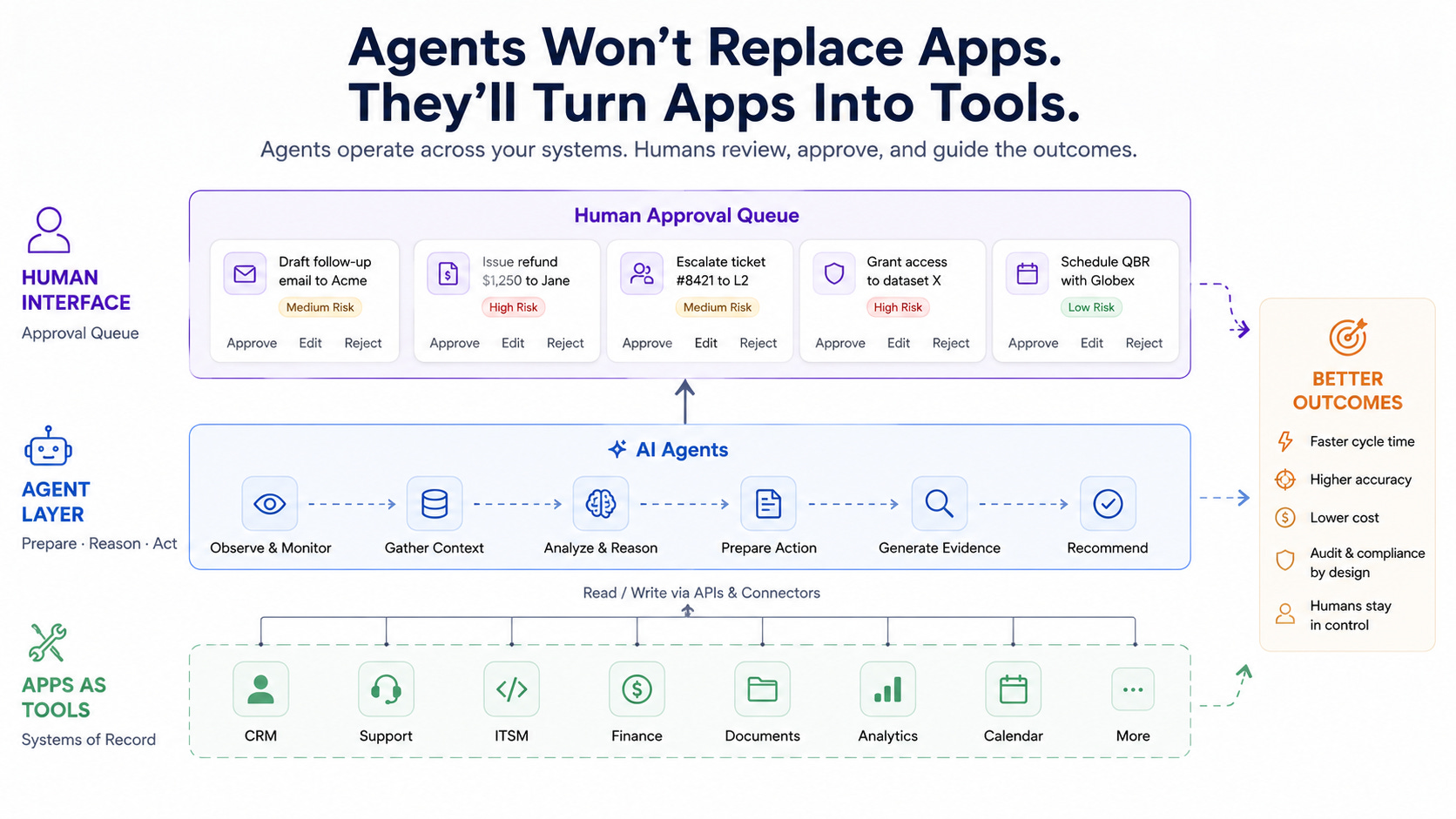
For the last decade, software has trained humans to become operators.
We open the dashboard, filter the table, find the record, update the field, send the message, create the task, move the ticket, refresh the report, and then repeat the same loop tomorrow.
Every app became a place where humans went to do work.
CRM for sales. Jira for engineering. Zendesk for support. Workday for HR. ServiceNow for operations. NetSuite for finance. Slack for coordination.
The user interface was the workplace.
But agentic software changes that assumption.
If agents can read records, call APIs, draft updates, compare policies, summarize history, and prepare actions, then humans should not need to click through every workflow step manually.
The app does not disappear.
It becomes a tool layer.
The human interface moves somewhere else: into a queue of agent-prepared work that humans review, approve, correct, or reject.
That is a bigger shift than adding a chatbot to every product.
It changes what software is for.
The old SaaS model was built around human navigation
Traditional SaaS assumes the human is the active operator.
The software stores the data, exposes the workflow, and waits for the user to move the work forward.
A sales rep opens CRM to update the opportunity. A support agent opens the ticketing system to reply to the customer. An engineer opens the incident dashboard to inspect alerts. A finance analyst opens the billing system to review exceptions. A compliance manager opens a repository to collect evidence.
The app is where the work happens.
That is why SaaS products have so many screens, filters, forms, tables, menus, permissions, and dashboards. The product has to expose every step because the human is expected to perform every step.
Agentic software changes the role of the human.
The human becomes less of a manual operator and more of a reviewer, approver, editor, and exception handler.
The agent prepares the work.
The human decides what is safe to accept.
That shift is bigger than putting a chat box on top of an existing product. It changes the center of gravity of the interface.
Chat is useful. It is not the end state.
A lot of teams assume the future of software is chat.
Ask the CRM a question. Ask the data warehouse a question. Ask the ticketing system a question. Ask the project management tool a question.
That is useful, but chat is still request-driven.
The human has to know what to ask. The human has to initiate the work. The human has to describe the context. The human has to decide what to do with the answer.
For many enterprise workflows, that is not enough.
The valuable agent is not the one waiting in a blank chat box. The valuable agent is the one watching the workflow, detecting what needs attention, preparing the next action, and showing the evidence behind it.
A sales agent should not wait for a rep to ask, “What should I do with this opportunity?”
It should say:
Three deals have stalled. One needs a follow-up. One has pricing risk. One has no next step after the last call. Here are the drafts. Approve, edit, or reject.
A support agent should not wait for a manager to ask, “Which tickets are at risk?”
It should say:
These five tickets are likely to reopen because the customer blocker was not resolved. Here is the evidence. Approve escalation or send the proposed response.
An incident agent should not wait for an engineer to ask, “What happened?”
It should say:
Latency increased after deploy v2.3.8. Checkout is affected. Similar incident occurred last month. Suggested SEV-2. Page Platform Payments?
That is not just chat.
That is agent-prepared work.
And agent-prepared work needs a different UI.
The new UI is review
When agents do more work in the background, the human does not need another dashboard full of raw data.
The human needs a queue of prepared decisions.
Each item in that queue should answer a few questions:
What is the agent proposing? Why is it proposing this? What evidence did it use? What systems will change? What is the risk? Can this be undone? Who needs to approve it? What happens if we reject it?
That is the approval-queue interface.
Not a blank chat box.
Not a giant analytics dashboard.
A structured list of agent-prepared actions waiting for human judgment.
Approve. Edit. Reject. Escalate. Ask for more evidence. Convert to draft. Send to another owner.
This is how humans stay in control without doing every manual step.
The agent does the preparation.
The human handles judgment.
The future interface is not where humans do every step.
It is where humans decide which agent-prepared work deserves to move forward.
Apps become tools
This does not mean SaaS apps go away.
They become the systems agents operate.
The CRM still stores customer records. The ticketing system still tracks issues. The billing system still owns invoices. The monitoring system still captures alerts. The document repository still stores policies. The project management tool still tracks work.
But the user may not open each app as often.
The agent reads from them, writes to them, and coordinates across them.
The app becomes part of the agent’s toolchain.
The human sees the outcome layer.
Instead of a sales rep opening CRM, Gong, email, Slack, and the calendar to decide what to do next, an agent prepares a short queue:
approve follow-up email, update deal stage, flag pricing risk, assign legal review, schedule next meeting.
Each item includes source evidence.
The rep still decides.
But the rep is no longer manually navigating five systems just to reach the decision.
That is the real shift.
Agents will not replace apps overnight.
They will turn apps into tools.
Suggested inline image
Place your image here.
Image concept: a clean two-layer diagram.
Top layer: Human Approval Queue
Approve → Edit → Reject → Escalate
Bottom layer: Apps as Tools
CRM → Tickets → Billing → Docs → Monitoring → Calendar
Middle: Agent prepares work with evidence
Caption:
Apps become the tool layer. The human interface becomes the approval layer.
Approval without evidence is just another inbox
An approval queue without evidence becomes a new kind of inbox.
If the agent says, “Approve this refund,” the human needs to know why.
Which policy applied? What invoice was checked? What customer tier is involved? Was the refund amount within threshold? Has this customer requested refunds before? Is there a contract exception? What happens after approval?
Without evidence, the human has to redo the work.
That destroys the value.
The approval queue must show the reasoning surface. Not hidden chain-of-thought, but operational evidence:
source records, retrieved documents, policy checks, tool outputs, confidence level, risk level, approval requirement, expected system change, and rollback option.
This is where many agent products will fail.
They will generate actions but not enough trust to approve them.
The winners will not be the agents that act the fastest.
They will be the systems that make approval feel safe.
The interface changes by risk
Not every agent-prepared action needs the same level of human review.
A low-risk action can be auto-approved. A medium-risk action may need human review. A high-risk action should require explicit approval. A critical action may need multiple approvals, policy checks, or escalation.
The interface should reflect this.
For low-risk work, the queue can be lightweight:
Drafted meeting summary. Saved to account.
For medium-risk work:
Prepared customer follow-up. Review before sending.
For high-risk work:
Refund recommended. Approval required before execution.
For critical work:
Permission change requested. Security review required.
This is how agentic products should scale autonomy.
Not all-or-nothing.
Risk-aware review.
The product should decide what the agent can do automatically, what it can draft, what it can recommend, and what it must escalate.
That means the UI is no longer just a place to perform tasks.
It becomes a control surface for autonomy.
Dashboards become context. Queues become action.
Dashboards are good at showing state.
They are less good at telling humans what needs a decision.
In agentic software, dashboards may become less central. The user does not want to stare at a wall of charts and decide what to inspect. The agent should monitor the state, detect meaningful changes, and prepare the decision.
The dashboard becomes background context.
The queue becomes the foreground.
This is already how many humans want to work. They do not want to open every app each morning and search for problems.
They want to know:
What needs my attention? What has already been prepared? What is safe to approve? What is blocked? What changed since yesterday? Where do I need to use judgment?
That is an approval queue.
It is not less powerful than a dashboard.
It is more focused.
The product design challenge
Designing an approval queue is harder than it looks.
If every agent action needs approval, the queue becomes a new inbox. If the agent hides too much evidence, humans will not trust it. If the agent asks for approval on low-value actions, users will ignore it. If the agent auto-approves too much, the system becomes risky. If the agent cannot explain why an item is in the queue, the human has to investigate manually.
So the product design challenge is not just “put approvals in the UI.”
The real challenge is deciding which work should appear, which work should be auto-resolved, which work needs review, which evidence should be visible, which edits should be allowed, which actions require escalation, and which rejected actions should become learning signals.
That last point matters.
The approval queue is not only a control layer.
It is a learning loop.
Every approval, edit, rejection, and escalation teaches the system what humans actually trust.
Over time, the product can move safe patterns from manual approval to assisted approval to automatic execution.
That is how agents earn autonomy.
The business model changes too
If apps become tools and humans move to approval queues, SaaS pricing may also shift.
The old model priced access: seats, users, dashboards, modules.
The agentic model may price work: resolved tickets, approved actions, completed workflows, reviewed evidence, qualified leads, handled exceptions, reduced triage time, lower reopen rate.
This is why the approval queue matters strategically.
It creates a visible unit of value.
Each queue item represents work the agent prepared and the human accepted, corrected, or rejected.
That becomes measurable.
You can track how much time was saved, how many actions were approved, how many were edited, how many were rejected, and which workflows improved.
A chat interface produces conversations.
An approval queue produces measurable work.
That is a better foundation for enterprise value.
What I would build first
If I were designing an agentic SaaS product, I would not start with a universal chat assistant.
I would start with one workflow where humans already review work manually.
Support escalations. Sales follow-ups. RFP answers. Compliance evidence. Incident triage. Billing exceptions. Customer onboarding risks.
Then I would build an approval queue around that workflow.
Each queue item would have the work object, the proposed action, the evidence, the risk level, the affected systems, the approval owner, the allowed edits, the rollback path, and the outcome metric.
The first version would not try to automate everything.
It would prepare better work for humans to review.
That is a strong wedge because it creates value before full autonomy. The product does not need to ask users to trust the agent blindly.
It helps them make better decisions immediately.
Final thought
The future of SaaS is not every app becoming a chatbot.
That is too small.
The bigger shift is that apps become operational layers for agents, and humans move to the supervision layer.
Agents gather context. Agents draft actions. Agents update systems. Agents monitor workflows. Agents prepare decisions.
Humans review what matters.
The best products will not make users click through more screens.
They will bring the right work to the right human with the right evidence at the right moment.
That is why agents will not replace apps.
They will turn apps into tools.
And the new interface will be the approval queue.
Discussion prompt
Where do you think the approval-queue UI appears first: sales follow-ups, support escalations, incident triage, compliance evidence, finance exceptions, or customer onboarding?