Build Agents, Not Chatbots
You didn’t build an AI product. You built a glorified search bar. Here is the actual playbook for building autonomous, high-ROI features.

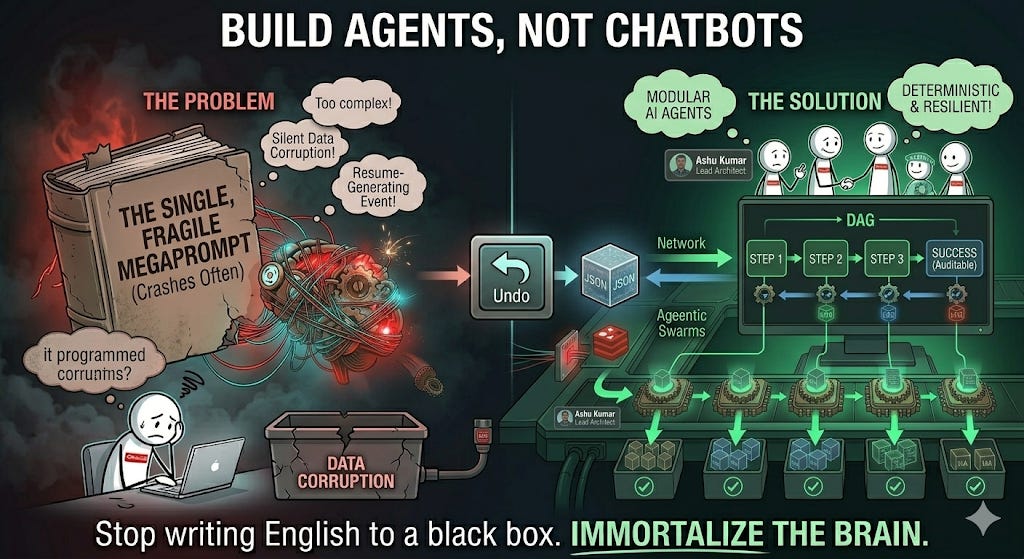
The Chatbot ROI Crisis
If you are a Product Manager who shipped an AI feature in the last 12 months, your analytics dashboard probably looks like this:
A massive spike in adoption during launch week, followed by a 90% drop-off by month two. Daily Active Users (DAU) on your “AI Assistant” are flatlining.
The executive team is panicked. They are asking if the prompt needs tweaking or if you should upgrade from GPT-4o to Claude 3.5 Sonnet.
Stop. The model is not the problem. Your product architecture is the problem.
You fell into the trap of building a “Conversational UI.” You assumed that because ChatGPT is a chat interface, your B2B SaaS product should also have a chat interface. But B2B users do not log into your software to chat. They log in to get work done.
If your AI only gives advice, drafts text, or summarizes data, you haven’t solved the user’s problem. You’ve just shifted their cognitive load from writing to reading and editing.
This is the Execution Gap. And it is the exact reason product teams must pivot to Agentic AI.
The Real Problem: The Execution Gap
Let’s look at a real-world SaaS problem: Customer Support Ticket Resolution.
The V1 “AI Wrapper” Approach (High Churn):
A user gets a ticket asking for a refund. They click the “AI Assistant” button. The AI reads the ticket, checks a vector database (RAG), and generates a suggested reply: “Hi, I can process this refund for you.”
Why it fails: The human still has to read the draft, manually open Stripe, locate the user, click “Refund,” go back to the ticket, paste the transaction ID, and hit “Send.” The AI didn’t do the work; it just typed the easy part. The friction remains.
The Agentic Approach (High ROI):
A ticket comes in. The human doesn’t click anything. In the background, an Agentic AI reads the ticket, uses an API tool to query Stripe, verifies the refund policy, processes the refund via the Stripe API, drafts the response with the real transaction ID, and flags it for final human review.
Why it wins: The execution gap is closed. The AI didn’t just summarize; it acted.
The Proper Channel Solution: How PMs Build Agentic Workflows
Transitioning from an AI wrapper to an Agentic product requires you to completely tear down your Conversational UI and rebuild the user journey.
Here is the three-step channel solution for Product Managers to build actual autonomous features:
1. Kill the Chat Box. Move to Async Background Jobs.
Chat UI is synchronous. The user types, and they sit there watching a blinking cursor wait for a response. This is a terrible user experience for complex tasks.
The Fix: Agentic AI is asynchronous. PMs need to design UI that treats AI like a background job. Users should trigger a workflow (e.g., “Onboard this list of 50 vendors”) and walk away. Your UI should show a progress bar or a Kanban board of what the AI is currently doing, not a chat window.
2. Give the AI “Hands” (Tool Calling & API Integration)
An LLM with RAG only has a brain—it can read and speak. An Agent has hands.
The Fix: Your engineering roadmap must shift from “Prompt Engineering” to “Tool Integration.” You need to expose your internal CRUD APIs (Create, Read, Update, Delete) securely to the LLM. The product value of your AI is entirely dependent on how many internal systems it has write-access to.
3. Design “Approval Gates,” Not Prompts
Users hate writing prompts. They are bad at it, and it feels like programming.
The Fix: Shift the UX from Prompting to Reviewing. The Agent should do 99% of the work in the background and then present the user with a highly structured “Approval Gate.” The UI should explicitly show: “Here is the data I found, here is the API action I am about to take, and here is the cost. Click Approve or Reject.” This builds user trust without requiring them to manage the model.
The Verdict: Service-as-Software
We are witnessing the death of traditional software-as-a-service. Why would a customer pay a monthly subscription for a CRM that forces them to do their own data entry, when your competitor is selling an Agentic CRM that updates itself?
If your product roadmap for this quarter is just adding more “AI summaries” and “suggested replies,” you are going to lose.
You need to close the Execution Gap. Take the chatbot off your UI, give your LLM access to your internal APIs, and start building digital workers that actually finish the job.