
If the Workflow Is Broken, AI Will Just Move the Mess Faster
Before adding an agent, fix ownership, handoffs, rules, and success metrics.

The support team added an AI agent to reduce backlog.
The first dashboard looked promising. Response time dropped. Tickets moved faster. Summaries became cleaner. Routing looked more consistent. Managers could finally see movement in the queue.
Then the same customers started coming back.
The tickets were technically closed, but the blockers were still there. Billing questions needed approval from another team. Product issues were routed to engineering without the right logs. Refund exceptions were answered with policy language but not resolved. Some customers reopened the same issue three times with slightly different wording.
The AI agent had improved motion through the workflow.
It had not improved resolution.
That is the danger of adding AI to a broken process. It can make the system look faster before anyone notices the underlying mess is still intact.
A broken workflow does not become healthy because an agent summarizes it, classifies it, routes it, or drafts a response for it. If ownership is unclear, the agent inherits that ambiguity. If the rules conflict, the agent packages the conflict in better language. If the handoff is weak, the agent moves the weak handoff faster. If the metric rewards activity, the agent optimizes activity.
AI does not erase workflow debt.
It operationalizes it.
The dashboard can improve while the work gets worse
This is why AI projects can look successful early.
The visible metrics move first. Faster response time. More completed tasks. More routed tickets. More generated summaries. More status updates. More dashboard activity.
Those numbers are easy to celebrate because they are easy to measure.
But the real workflow may depend on slower, harder questions. Did the customer become unblocked? Did the next owner accept responsibility? Did the decision become clearer? Did the same issue stop recurring? Did the process become less dependent on informal knowledge inside people’s heads?
In the support example, the agent was evaluated against the wrong version of success. It was rewarded for handling tickets, not resolving customer problems. It could draft a response, but it could not fix the stale knowledge base. It could route to engineering, but it could not force engineering to accept poorly formed escalations. It could summarize policy, but it could not clarify who had authority to approve exceptions.
The AI agent was not the root cause of the failure.
It was the accelerator.
And when a broken workflow accelerates, the mess does not disappear. It spreads.
The official process is often not the real process
Every company has two workflows.
The one documented in the system.
And the one people actually use to get work done.
The documented workflow says: route billing issues to billing, product bugs to engineering, implementation blockers to customer success, and escalations to the right queue.
The real workflow says something else.
Ask Maya because she knows which billing exceptions are allowed. Ping the platform team before escalating this type of bug. Do not trust that dashboard after 6 p.m. because the sync lags. The runbook is outdated, but the Slack thread from last month has the real fix. The service owner in the catalog is wrong. The policy changed, but the public help article has not been updated.
Humans carry these gaps quietly. They know which source of truth is really trusted. They know which team will reject an escalation. They know which rule has exceptions. They know where the workflow lies.
Then an AI agent enters the process and follows the official version.
It reads the documented policy. It checks the listed owner. It routes to the queue. It summarizes the stale runbook. It updates the CRM field. It does exactly what the system appears to ask.
That is when workflow debt becomes visible.
The agent exposes the gap between how the company says work happens and how work actually happens.
AI is useful when the workflow is legible
This does not mean AI should stay out of workflows. The opposite is true.
AI becomes much more valuable when the workflow is legible.
When the owner is clear, the agent knows where to escalate. When success is defined, the agent can optimize for the right outcome. When policies are current, the agent can reason against reliable rules. When handoffs are explicit, the agent can prepare the next team instead of throwing work over the wall. When the source of truth is trusted, the agent can gather context without amplifying bad data.
That is the difference between adding AI to chaos and adding AI to a system.
In a healthy support workflow, an agent can identify unresolved blockers before a ticket is closed. In a healthy incident workflow, an agent can gather logs, metrics, runbooks, deploy history, and ownership into an escalation brief. In a healthy RFP workflow, an agent can draft sourced answers and route unknowns to subject matter experts. In a healthy compliance workflow, an agent can find evidence, check freshness, and flag gaps.
The agent becomes useful because the workflow gives it a meaningful job.
Not “help with support.”
Instead:
detect whether the customer is actually unblocked before the case is closed.
Not “help with incidents.”
Instead:
assemble the evidence an on-call engineer needs to decide severity and ownership.
Not “help with compliance.”
Instead:
map each control to fresh evidence and flag missing artifacts before the review.
AI works better when the workflow tells it what progress means.
The wrong question starts the wrong project
Many AI projects begin with the same question:
Where can we add AI?
That question sounds practical, but it often leads to shallow automation. A summary here. A classifier there. A chatbot on top. An agent between two systems. A polished layer over a process nobody has fixed.
The better question is:
Where does work get stuck, repeated, reopened, escalated, or misunderstood?
That question forces a different conversation.
If work gets stuck because nobody owns the decision, the agent should not pretend to decide. It should surface the ownership gap.
If work gets repeated because upstream data is bad, the agent should not keep cleaning the same mess. The data source needs to be fixed.
If work gets reopened because users are not actually unblocked, the metric should not be ticket closure. It should be resolution.
If work gets escalated because policy is unclear, the agent should not invent clarity. The policy needs an owner.
This is the workflow diagnosis that should happen before agent design.
Because if the workflow problem is not named, the AI solution will optimize the wrong thing beautifully.
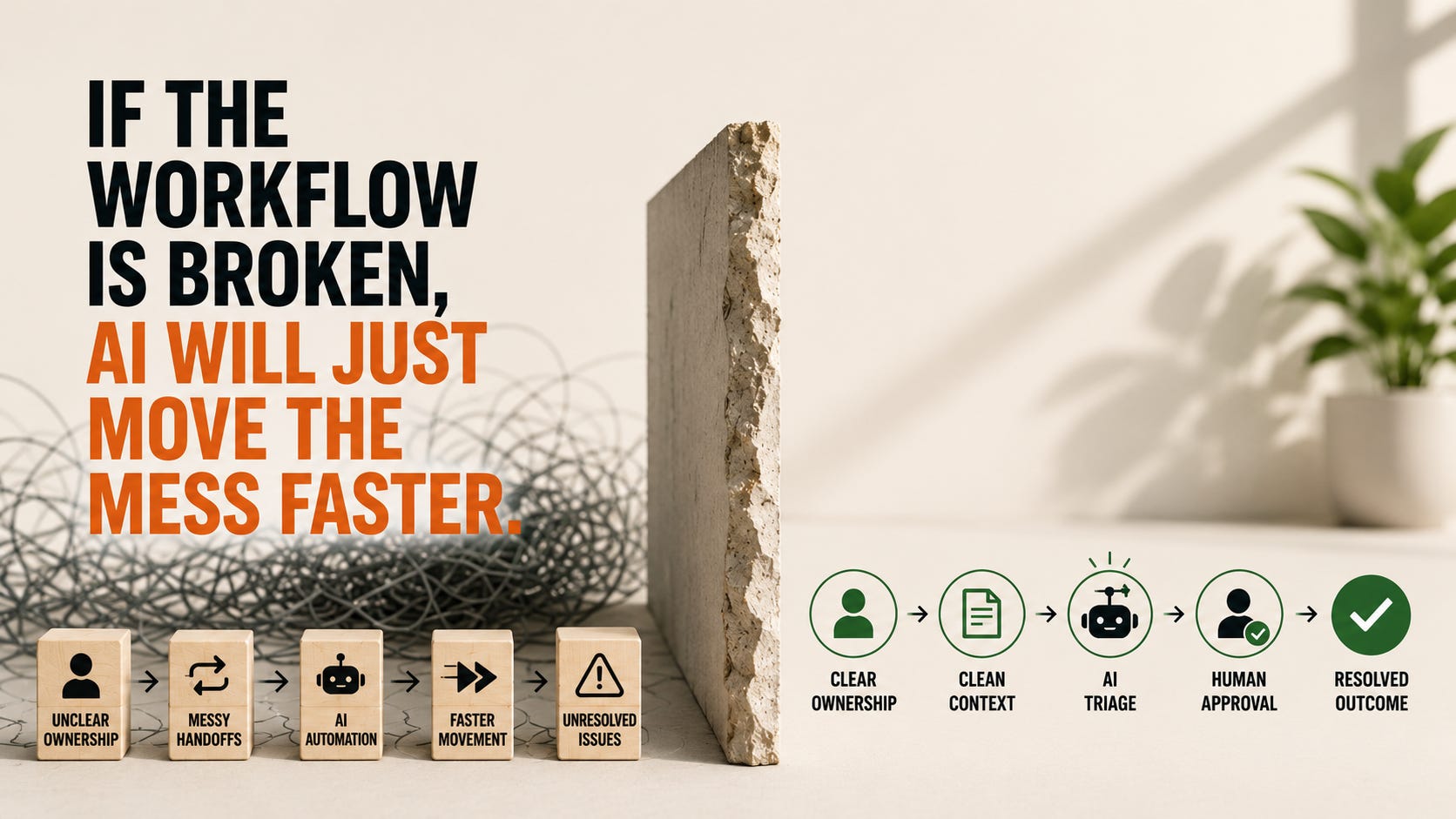
Suggested inline image placement
Place the simple visual here.
Image idea: two lanes.
Broken Workflow + AI
Unclear owner → messy handoff → AI summary → faster routing → unresolved issue
Fixed Workflow + AI
Clear owner → clean context → AI triage → human approval → resolved outcome
Caption:
AI should accelerate a workflow only after the workflow knows where it is going.
The workflow readiness test
Before adding an AI agent, I would ask six questions.
Who owns the outcome? Not the task. Not the queue. The outcome. If nobody owns the result, the agent will inherit the ambiguity.
What does success mean? If success is measured by activity, the agent will create more activity. If success is measured by resolution, the agent can be designed around resolution.
Where does context live? If context is scattered across documents, systems, conversations, and history, AI may help. But if the context is missing, stale, or untrusted, AI may simply make bad information easier to consume.
Which decisions are rules, and which require judgment? Stable rules should become software. Messy, language-heavy, context-dependent decisions may be good places for AI assistance.
What happens when the agent is wrong? If one wrong action can move money, change permissions, break production, or create customer risk, the first version should draft or recommend. It should not execute.
Could a simpler fix solve most of the pain? A better form, API, dashboard, workflow owner, approval path, or knowledge base cleanup may beat an AI agent.
This is not anti-AI.
This is how AI earns its place.
A consultant should sometimes say: “Not yet”
For AI consultants, this is one of the most important trust-building moments.
The client asks for an agent. The team is excited. The demo opportunity is obvious. There is pressure to show something intelligent quickly.
But the stronger move may be to say:
You may need an agent here, but first we need to fix the workflow it will operate inside.
That sentence changes the relationship.
It shows that the goal is not to force AI into every process. The goal is to improve the outcome.
Sometimes the recommendation will still be an AI agent. Sometimes it will be a rules engine, a better approval path, a cleaner knowledge base, an API integration, a redesigned handoff, or a dashboard people can actually trust.
That honesty is not a weaker AI strategy.
It is the foundation of a better one.
Because clients do not actually want AI. They want shorter cycle times, fewer errors, lower cost, better decisions, cleaner handoffs, and more reliable operations.
AI is one way to get there.
It is not the destination.
When AI finally belongs
After the workflow is clarified, AI can become powerful.
The agent can gather context humans used to chase manually. It can compare current work against history. It can detect missing information before a handoff. It can draft the next action with evidence. It can warn when confidence is low. It can explain why a task should be escalated. It can help humans make better decisions faster.
But now the agent has boundaries.
It knows what object of work it is handling. It knows who owns the outcome. It knows which sources to trust. It knows which actions are read-only, which are draft-only, and which require approval. It knows what success looks like. It knows when to stop.
That is the difference between a chatbot placed on top of a workflow and an agent designed into one.
The first produces output.
The second improves the system.
Final thought
AI does not remove the need for workflow design.
It makes workflow design more important.
Once an agent enters a process, it can move work faster, generate more outputs, trigger more actions, and create more downstream consequences.
That is useful when the workflow is clear.
It is risky when the workflow is broken.
So before adding AI, look underneath the automation request.
Who owns the outcome? Where does the work get stuck? Which rules are unclear? Which handoffs fail? Which metric is rewarding the wrong behavior? What does success actually mean?
If those answers are fuzzy, AI will not magically create clarity.
It will move the mess faster.
And faster mess is still mess.