
The Agentic Circuit Breaker
How to stop AI agents before retries, tool calls, and bad assumptions become production incidents.

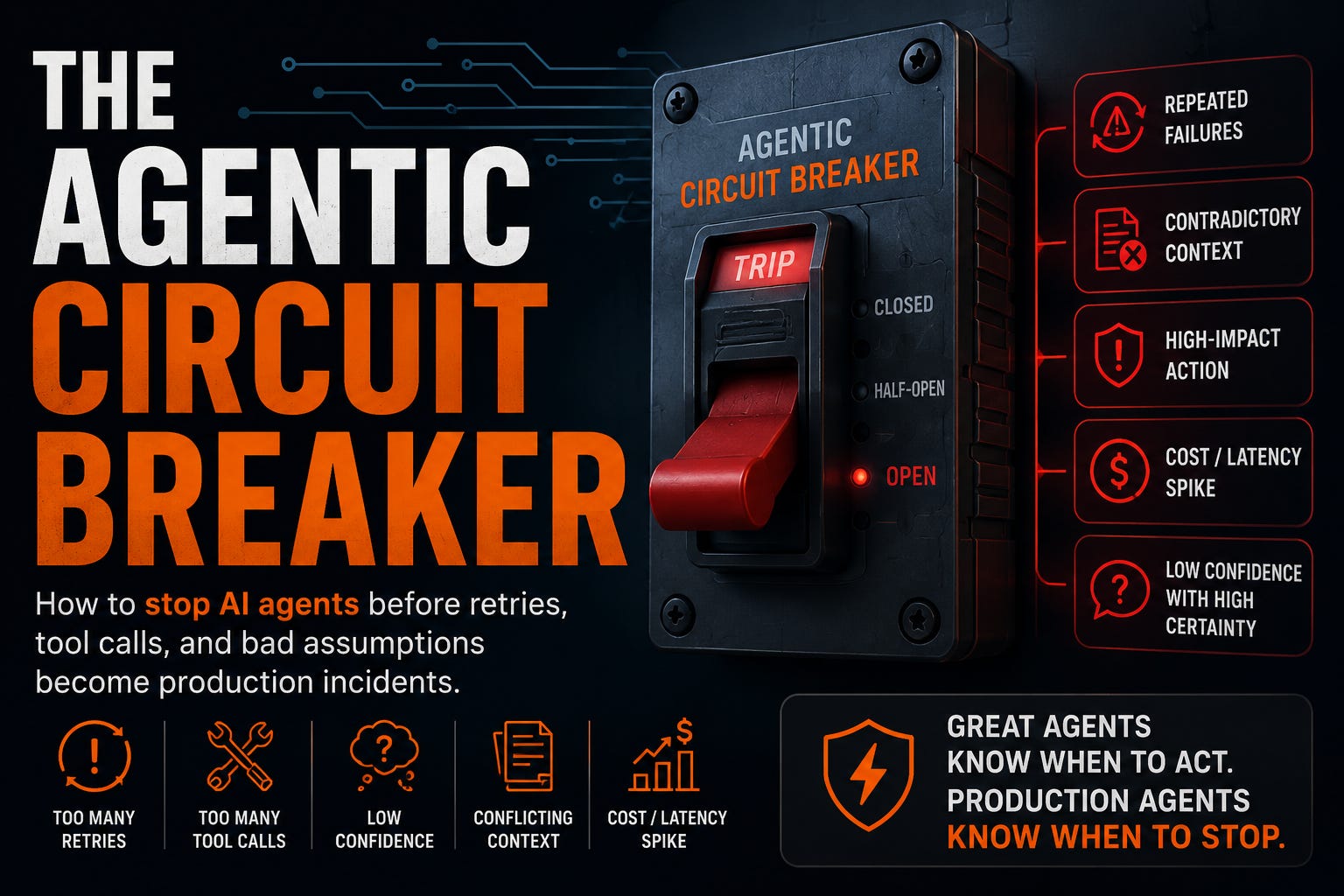
Most AI agent failures do not begin as disasters.
They begin as small mistakes.
A tool call returns incomplete data.
The agent retries with slightly different parameters.
A retrieved document is stale.
The agent assumes it is still valid.
An API times out.
The agent calls another tool to “work around” the issue.
A user gives an ambiguous instruction.
The agent fills in the gap with confidence.
Individually, each step looks reasonable.
Together, they become an incident.
This is what makes agentic systems different from normal software. Traditional software usually fails at a specific line, service, or dependency. AI agents often fail through a chain of plausible decisions.
The agent is not “broken” in an obvious way.
It is still planning.
Still calling tools.
Still generating responses.
Still trying to complete the task.
That is the dangerous part.
A production AI agent does not only need intelligence.
It needs a way to stop itself.
It needs a circuit breaker.
What is a circuit breaker?
In traditional software architecture, a circuit breaker prevents repeated failures from cascading across a system.
If a service keeps failing, the circuit breaker opens. Instead of repeatedly calling the broken dependency, the system stops, degrades gracefully, or routes to a fallback.
The goal is simple:
Do not let one failing component take down the whole system.
Agentic systems need the same idea, but at a different layer.
An agentic circuit breaker stops an AI agent when its behavior becomes risky, expensive, uncertain, repetitive, or misaligned with the task.
It does not wait for a full incident.
It catches the early signs.
Too many retries.
Too many tool calls.
Low confidence.
Contradictory context.
Policy-sensitive action.
Escalating cost.
Unexpected permission request.
Repeated failure to complete the same step.
When those signals appear, the agent should not keep improvising.
It should pause, escalate, fallback, or ask for clarification.
The retry trap
One of the most common agentic failure modes is the retry trap.
The agent tries something.
It fails.
It tries again.
It fails differently.
It tries a new tool.
It receives partial data.
It reformulates the task.
It keeps going.
From the outside, this looks like persistence.
In production, it can become uncontrolled execution.
The agent burns tokens.
It increases latency.
It creates duplicate actions.
It pollutes context with failed attempts.
It may eventually perform the wrong action simply because it is optimizing for task completion at any cost.
This is why “try harder” is not a production strategy.
A retry policy should be explicit.
For example:
Maximum 2 retries per tool
Maximum 5 tool calls per task
Maximum 60 seconds of execution time
Maximum cost per workflow
Escalate after repeated low-confidence reasoning
Stop if retrieved sources conflict
Require approval before irreversible actions
Without these limits, the agent’s default behavior may be to continue until something works.
Sometimes “something works” is exactly how the incident starts.
The five signals that should trip the breaker
A production agent should not rely on one failure signal. It needs multiple tripwires.
Here are five that matter.
1. Repeated tool failure
If the same tool fails multiple times, the agent should stop calling it.
This sounds obvious, but many agents keep retrying because the prompt tells them to complete the task.
Tool failure should trigger a controlled path:
Stop. Explain the failure. Try an approved fallback. Escalate if needed.
The agent should not invent a workaround using unrelated tools.
2. Contradictory context
If retrieval returns conflicting information, the agent should not confidently choose one unless the system defines source priority.
Example:
One document says refunds are allowed within 30 days.
Another says refunds are allowed within 14 days.
A third document is undated.
The agent should not guess.
The circuit breaker should trigger:
Conflicting policy detected. Ask for clarification or route to human review.
Contradictory context is not a reasoning challenge.
It is an operational risk.
3. High-impact action
Some actions should always slow the agent down.
Refunding money.
Changing account permissions.
Deleting records.
Sending external emails.
Updating production systems.
Approving legal, financial, or HR-sensitive decisions.
The agent may be allowed to draft these actions.
But execution should require a higher threshold: approval, policy validation, or human confirmation.
The more irreversible the action, the lower the tolerance for autonomy.
4. Cost or latency spike
Agents can become expensive quietly.
A task that should take one model call becomes ten.
A simple answer becomes multiple retrieval passes.
A tool failure creates repeated retries.
A long context window grows with every step.
The circuit breaker should monitor cost per task, token usage, number of calls, and execution time.
When the agent crosses the budget, it should not keep thinking.
It should compress context, use a cheaper model, ask for clarification, or stop.
Agentic FinOps is not only about monthly bills.
It starts at the task level.
5. Low confidence with high certainty language
This is one of the most dangerous patterns.
The agent is uncertain internally but sounds confident externally.
It uses phrases like:
“The best approach is…”
“You should…”
“This confirms…”
“The issue is definitely…”
But the evidence is weak, stale, or incomplete.
A good circuit breaker should detect when evidence quality is low and force the agent into a safer mode:
“I don’t have enough reliable information to complete this. Here is what I know, what is missing, and what needs confirmation.”
That is not failure.
That is production-grade behavior.
The three states of an agentic circuit breaker
A simple model is enough for most teams.
Closed
The agent is operating normally.
Tools are healthy.
Context is clean.
Cost is within budget.
Confidence is acceptable.
The task is within scope.
Open
The breaker has tripped.
The agent must stop autonomous execution.
It may explain what happened, ask for clarification, escalate to a human, or move to a safe fallback.
But it should not continue acting as if everything is normal.
Half-open
The system allows limited recovery.
The agent may retry once, use a safer tool, reduce autonomy, or continue in draft-only mode.
This state is important because not every failure requires a full stop. Sometimes the right response is degraded autonomy.
For example:
“I can draft the refund response, but I cannot execute the refund until a support lead approves it.”
That is a healthy half-open state.
most teams build monitoring but skip the named trigger - they see the breakdown, not the threshold that should have tripped first.
who actually owns the condition that stops the agent?
Hey Ashu
I have been following your line of thinking on agentic systems for a while and this one landed differently. The retry trap and the low confidence with high certainty language pattern are two of the most honest descriptions I have read of how agents actually fail in the field.
I am working on something adjacent. A governance architecture for AI agents in critical sectors, with execution gates, context validation before irreversible actions and structured human escalation baked into the core. I got to those decisions the hard way, through real production failures, not upfront design.
What struck me reading your article is that you named and framed conceptually what I had built through trial and error. Same underlying problem, very similar structural responses.
If that sounds interesting to you, I would be happy to share more about how those principles ended up implemented in a real system. Might be a useful exchange for both sides.