
The Autonomy Gap
Companies are racing to deploy AI agents, but most are not ready for what happens when software starts making decisions, moving work, and creating consequences.

The agent demo worked because nothing real was at stake.
The agent found the document. It drafted the email. It updated the ticket. It suggested the next step. Everyone nodded.
Then someone asked the production question.
Can it send that email?
Can it change that customer record?
Can it approve that refund?
Can it escalate that account?
Can it trigger that workflow?
Can it keep doing this when nobody is watching?
That is where the conversation changes.
Not because the model suddenly became weak.
Because the company discovered it had an autonomy gap.
The technology may be capable enough to act, but the organization is not always ready to absorb the consequences of that action.
That gap is becoming the real enterprise AI bottleneck.
Gartner has predicted that more than 40% of agentic AI projects will be cancelled by the end of 2027 because of escalating costs, unclear business value, or inadequate risk controls. McKinsey’s latest AI research also points to a similar direction: broad AI adoption is happening, but many organizations still have not embedded AI deeply enough into workflows to create material enterprise-level benefits. (Gartner)
That tells us something important.
The hard part is no longer only whether AI can reason, summarize, classify, draft, or call tools.
The hard part is whether the company has an operating model for autonomy.
The demo is not the autonomy test
Most agent demos test capability.
Can the agent retrieve the right document?
Can it understand the customer issue?
Can it call the right API?
Can it write a good response?
Can it complete a task across multiple steps?
Those are useful tests.
But they are not the autonomy test.
The autonomy test begins when the agent can create consequences.
When it can update a record. Send a message. Route a case. Trigger a refund. Change a workflow. Escalate a customer. Open a ticket. Close a ticket. Recommend a decision that someone else will trust.
That is a different kind of system.
A chatbot gives an answer.
An agent moves work.
And once software starts moving work, the company needs to answer questions that demos usually avoid.
Who owns the outcome?
What is the agent allowed to do?
What evidence must it show before action?
Where does uncertainty go?
What happens when it is wrong?
What cost can it create while trying to finish the task?
Can we reconstruct what happened later?
What business metric proves this was worth deploying?
These are not prompt-engineering questions.
They are operating-model questions.
And most companies are behind on them.
Deloitte’s enterprise AI work frames the next stage of AI success around moving from ambition to activation, with emphasis on work redesign, governance, operating models, and measurable ROI. That aligns with what many teams are discovering in production: deployment is easier than redesigning how work should actually happen. (Deloitte)
Autonomy is not a feature
A lot of AI product language makes autonomy sound like a product capability.
“Autonomous agents.”
“Self-directed workflows.”
“AI employees.”
“Agents that take action.”
But autonomy is not just a feature you turn on.
It is a responsibility you distribute across the company.
The moment an agent acts inside a workflow, autonomy touches business ownership, security, compliance, operations, finance, customer experience, and engineering.
A support agent that drafts a reply is one thing.
A support agent that sends the reply to an enterprise customer is another.
A finance agent that identifies invoice exceptions is one thing.
A finance agent that approves payments is another.
An incident agent that summarizes logs is one thing.
An incident agent that triggers a rollback is another.
The same model can sit behind all of these systems.
But the autonomy level is completely different.
That means the governance cannot be the same.
The more consequences an agent can create, the more explicit the operating model needs to become.
The six autonomy gaps
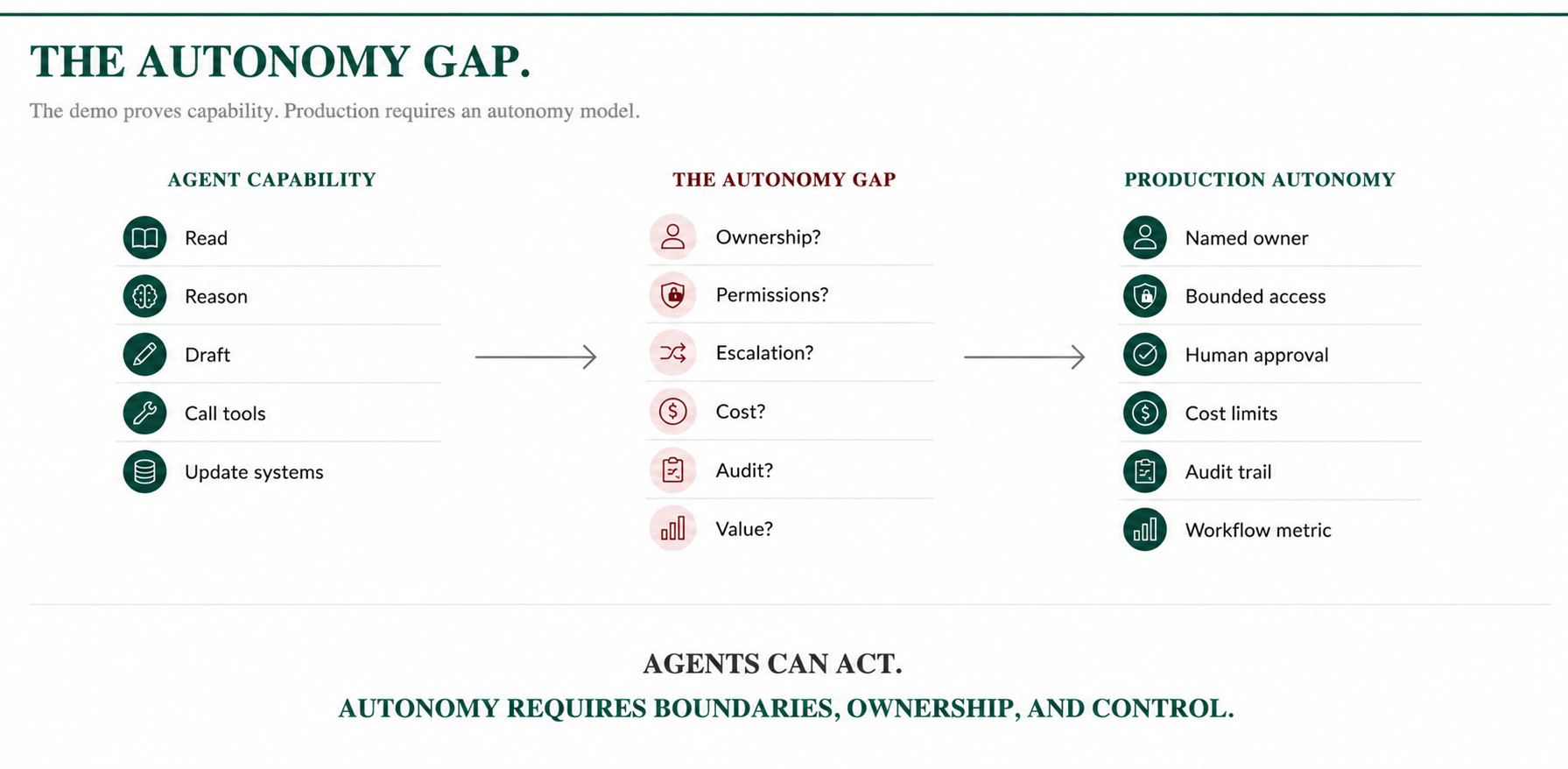
When agentic AI projects move from demo to production, they usually hit six gaps.
Not all at once.
But eventually.
Ownership gap.
Permission gap.
Escalation gap.
Cost gap.
Audit gap.
Value gap.
These are the places where autonomy breaks if the company has not done the hard work underneath.
1. The ownership gap
The first autonomy gap is ownership.
An agent takes an action. Something goes wrong. The company asks a simple question:
Who owns this?
The AI team says the model behaved within expected limits.
The platform team says the integration worked.
The business team says the workflow was followed.
The vendor says the configuration was approved.
The compliance team says the policy was ambiguous.
The user says they trusted the recommendation.
Everyone can explain their part.
Nobody owns the consequence.
That is the ownership gap.
It is easy to hide this gap when humans perform the work manually. People know who to ask. They escalate through relationships. They use judgment. They patch the process quietly.
Agents do not have that same informal network unless we design it.
Every production agent needs a business owner and a technical owner.
The business owner owns the workflow outcome: customer impact, policy, approval rules, success metrics, and acceptable risk.
The technical owner owns the runtime: reliability, tool access, observability, security, deployment, and failure handling.
Without both, the agent becomes nobody’s responsibility.
And if nobody owns the agent, the agent should not own the work.
2. The permission gap
The second gap is permission.
Most companies are used to thinking about software permissions in terms of users.
Can this employee access the CRM?
Can this manager approve the invoice?
Can this engineer deploy to production?
Can this analyst export data?
Agents make this harder because they can combine access, reasoning, and action.
An agent may read from one system, summarize context from another, make a recommendation using a policy document, and then call an API that changes the state of the business.
That means permission design cannot stop at “can this agent access the tool?”
The better question is:
What can the agent do with the tool, under which conditions, for which workflow, at which risk level, with what evidence, and with whose approval?
There is a big difference between:
Read customer record.
Draft customer response.
Send customer response.
Apply account credit.
Approve refund.
Change contract status.
Each step increases autonomy.
Each step needs a different boundary.
A production agent needs permission tiers.
It can detect.
It can summarize.
It can draft.
It can recommend.
It can request approval.
It can execute only when conditions are safe.
Most companies do not need fully autonomous agents on day one.
They need controlled autonomy with clear permission boundaries.
The permission gap appears when the agent’s capability grows faster than the company’s control model.
3. The escalation gap
The third gap is escalation.
A good production agent should not only know what to do.
It should know when to stop.
This is one of the most underrated parts of agent design.
What happens when the data is incomplete?
What happens when the policy conflicts with the customer tier?
What happens when the confidence is low?
What happens when the requested action is high-risk?
What happens when the tool call fails?
What happens when the agent sees something outside its scope?
What happens when two systems disagree?
If the answer is “the agent keeps trying,” the system is dangerous.
If the answer is “the agent fails silently,” the system is useless.
If the answer is “everything goes back to a human,” the system may not create much leverage.
The right answer is designed escalation.
Some cases should go to the workflow owner.
Some should go to a specialist.
Some should go to compliance.
Some should go to security.
Some should go to engineering.
Some should be parked until more evidence arrives.
Some should be blocked completely.
Escalation is not a fallback.
It is part of the architecture of autonomy.
The safest agents are not the ones that always act.
They are the ones that know when action is no longer appropriate.
4. The cost gap
The fourth gap is cost.
This is where agentic systems behave very differently from traditional software.
A normal SaaS workflow has fairly predictable usage.
An agentic workflow may reason, retry, call tools, search documents, generate intermediate outputs, validate responses, loop through planning steps, and ask other agents for help.
That can create invisible cost.
One failed task can become ten model calls.
One vague instruction can trigger repeated tool use.
One poorly scoped agent can run across too many systems.
One team’s experiment can become a recurring operational expense.
One department’s agents can multiply before finance, security, or platform teams even know they exist.
That is why autonomy needs cost controls.
Token budgets.
Tool-call limits.
Retry limits.
Runtime limits.
Approval thresholds for expensive workflows.
Visibility by agent, team, workflow, and business outcome.
The question is not only “did the agent complete the task?”
The question is:
How much did it spend to complete the task, and was the outcome worth it?
This is one reason some agentic AI projects will struggle. Gartner’s cancellation prediction specifically points to escalating costs and unclear business value as major risks for agentic AI projects. (Gartner)
Autonomy without cost control becomes financial fog.
And enterprises do not scale fog for long.
5. The audit gap
The fifth gap is auditability.
When an agent makes a recommendation or takes an action, the company needs to reconstruct what happened.
What did the agent see?
Which data sources did it use?
Which documents were retrieved?
Which tools were called?
Which policy was applied?
Which model and prompt version were used?
What did the agent recommend?
What did the human approve, edit, or reject?
What changed in the system?
What failed?
What was retried?
What was escalated?
If the company cannot answer these questions, it cannot govern the agent.
This does not mean logging hidden chain-of-thought.
That is not the right control surface.
The enterprise needs operational evidence: inputs, retrieved sources, tool calls, permission checks, policy decisions, approvals, outputs, actions, failures, and final state changes.
This is the audit layer for autonomy.
Without it, every incident becomes a forensic guessing game.
And every regulator, executive, or customer complaint becomes harder to answer.
A human employee leaves a trail through systems, approvals, emails, tickets, and managers.
Agents need an equivalent operational trail.
Not because every agent is high-risk.
But because every autonomous system needs accountability.
6. The value gap
The sixth gap is value.
This may be the most important one.
Many agent projects start with excitement around capability.
The agent can write.
The agent can search.
The agent can summarize.
The agent can plan.
The agent can use tools.
The agent can coordinate tasks.
But capability is not value.
Value is a business metric that improves.
Faster claim review.
Lower cost per support case.
Reduced invoice exception backlog.
Shorter audit preparation.
Higher first-contact resolution.
Fewer reopened tickets.
Faster incident triage.
Reduced approval cycle time.
More accurate routing.
Less manual review.
If the project cannot name the metric, it cannot prove the autonomy is worth it.
This is where many enterprise AI efforts struggle. McKinsey’s research says that while AI use is now widespread, organizations often have not embedded AI deeply enough into workflows and processes to realize material enterprise-level benefits. Its research also highlights workflow redesign as a major factor linked to EBIT impact from gen AI. (McKinsey & Company)
That is the lesson.
Agents do not create value because they are autonomous.
They create value when autonomy improves a measurable workflow outcome.
Without that, the project becomes theater.
Interesting.
Impressive.
Hard to scale.
Why agentic AI projects get cancelled
Agentic AI projects will not fail only because the models are bad.
Some will fail because the use case was vague.
Some will fail because the agent had too much access.
Some will fail because no one owned the outcome.
Some will fail because cost grew faster than value.
Some will fail because every edge case escalated back to humans.
Some will fail because the workflow was never redesigned.
Some will fail because the company could not audit what happened.
Some will fail because the demo solved a task, but production required an operating model.
This distinction matters.
A failed agent project may look like a technology failure.
But underneath, it may be an autonomy failure.
The company gave software the ability to move work before defining the boundaries, responsibilities, and economics of that movement.
That is the autonomy gap.
The safe path is assisted autonomy
The answer is not to avoid agents.
The answer is to scale autonomy gradually.
The safest path looks like this:
Detect.
Draft.
Recommend.
Review.
Approve.
Act.
Auto-act.
Most companies should not start at the end.
They should start where the agent can create value without creating uncontrolled consequences.
For example, a support agent can first detect likely escalations.
Then draft an escalation brief.
Then recommend an owner.
Then route low-risk cases for review.
Then act automatically only for cases that meet clear conditions.
A finance agent can first identify invoice exceptions.
Then collect evidence.
Then recommend a resolution path.
Then request approval.
Then auto-resolve only low-risk, repeatable exceptions.
An incident agent can first summarize alerts.
Then attach logs and recent deploys.
Then recommend severity.
Then page the right team.
Then trigger mitigation only after strict approval boundaries are met.
This is how autonomy earns trust.
Not through a single leap.
Through progressive permission.
The best agent systems will have autonomy levels, not autonomy slogans.
Autonomy needs a control surface
If agents are going to act across systems, enterprises need a control surface.
Not just a prompt library.
Not just a model gateway.
Not just a dashboard of usage.
A real autonomy control surface should show:
Which agents exist.
Who owns them.
What workflows they operate in.
What systems they can access.
What actions they can take.
What requires approval.
What they cost.
Where they fail.
What they escalated.
What they changed.
What business metric they improved.
This is the difference between agent experimentation and agent operations.
Experiments can live in notebooks, prototypes, and demos.
Production autonomy needs inventory, ownership, controls, observability, and review.
This is why agent sprawl will become a real enterprise issue.
Every team will want agents.
Sales will want follow-up agents.
Support will want triage agents.
Finance will want exception agents.
Compliance will want evidence agents.
Engineering will want incident agents.
HR will want onboarding agents.
Legal will want contract agents.
That is not bad.
But without a control surface, the company will not know where autonomy exists, what it can do, what it costs, or who is accountable for it.
You cannot govern autonomy you cannot see.
The human role does not disappear
There is a lazy version of the agent story that says humans disappear from the workflow.
That is not how serious enterprise adoption usually works.
The human role changes.
Humans move from manual execution to supervision, exception handling, approval, policy design, and outcome ownership.
The agent gathers context.
The human judges risk.
The agent drafts action.
The human approves high-impact work.
The agent detects exceptions.
The human resolves ambiguity.
The agent follows policy.
The human updates policy when reality changes.
This is not less human.
It is a different human role.
But companies need to design that role intentionally.
Otherwise, they create the worst version of both worlds:
Agents that are not autonomous enough to create leverage.
Humans who still have to check everything.
More review work.
More uncertainty.
More cost.
More tools.
No clear value.
The goal is not to remove humans from every loop.
The goal is to put humans in the right loop.
The companies that win will not have the most agents
The companies that win will not be the ones with the most agents.
They will be the ones with the clearest autonomy model.
They will know which workflows are ready for autonomy.
They will know which actions require approval.
They will know where uncertainty escalates.
They will know how costs are controlled.
They will know how to audit outcomes.
They will know which metrics prove value.
They will know when an agent should stop.
That is the real maturity curve.
Not chatbot adoption.
Not number of pilots.
Not how many teams experimented.
But how clearly the company can answer:
What are we allowing software to decide, and why?
Final thought
The next enterprise AI bottleneck is not just model capability.
It is autonomy readiness.
The agent demo will keep getting better.
The models will improve.
The tools will become easier to connect.
The workflows will look more automatable.
But production will keep asking the same hard questions.
Who owns the outcome?
What can the agent do?
Where does it stop?
Who approves the risk?
What does it cost?
Can we audit what happened?
Did the business result improve?
That is the autonomy gap.
And closing it is not only a technical problem.
It is an operating-model problem.
The companies that understand this will scale agents carefully, deliberately, and successfully.
The companies that ignore it will deploy autonomy faster than they can govern it.
The future will not belong to the organizations with the most AI agents.
It will belong to the organizations that know exactly how much autonomy each agent deserves.
Discussion prompt
Where do you see the biggest autonomy gap today: ownership, permissions, escalation, cost control, auditability, or proving business value?