
The "God Model" is Dead: Architecting Agentic Swarms with MCP and the Sidecar Pattern
There is a dangerous architectural fallacy emerging in the AI industry.

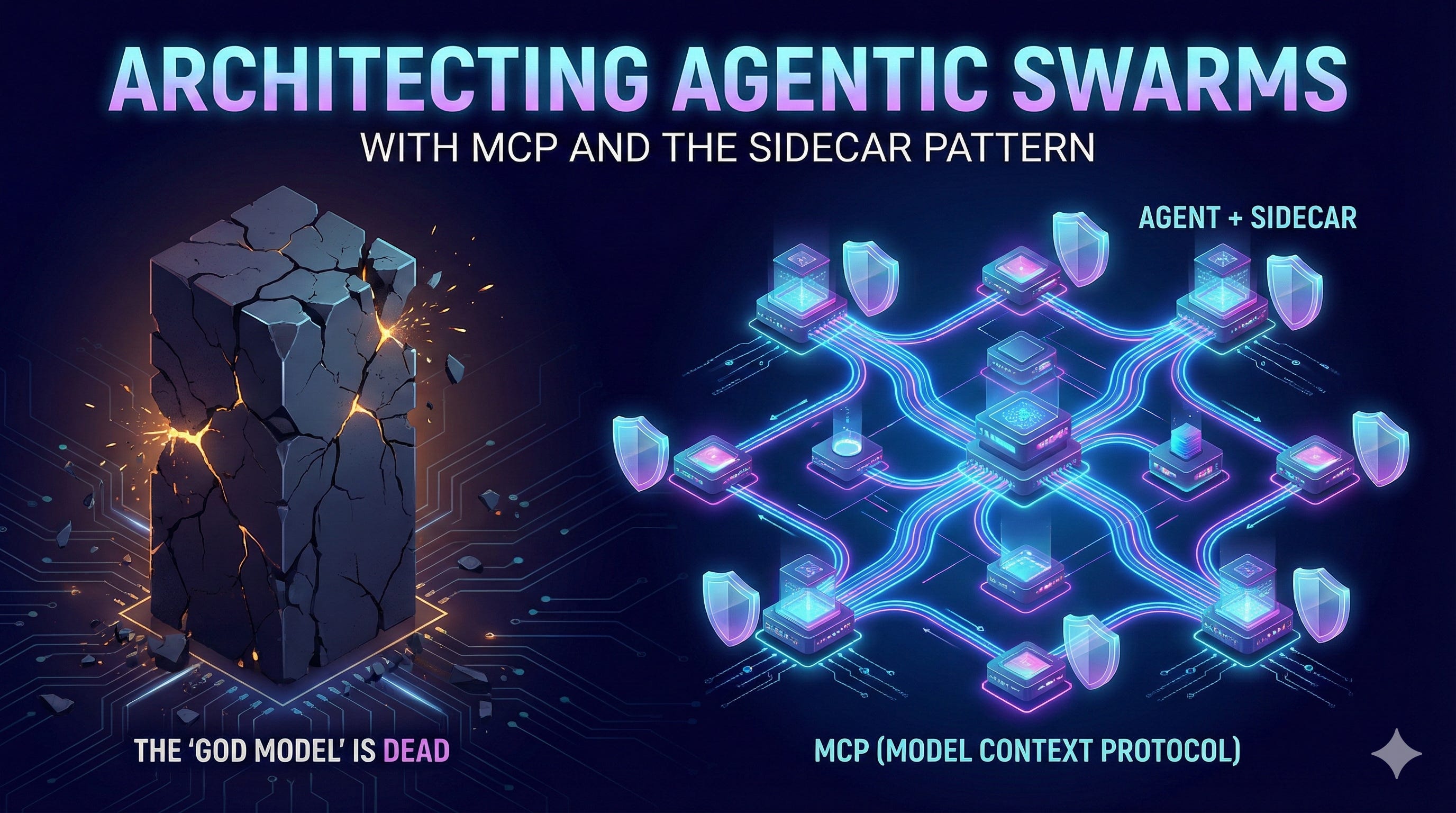
Teams are building what I call the “God Model.”
The pattern is predictable. Take a powerful foundation model. Give it access to dozens of tools. Stuff its prompt with governance policies, schemas, and operational context. Then expect it to reliably orchestrate your infrastructure.
When it works, it feels like magic.
When it fails, it fails catastrophically.
The model selects the wrong tool. It ignores a security constraint buried deep in the prompt. It hallucinates parameters. It burns tokens and produces unpredictable outcomes.
This isn’t a model problem.
It’s an architecture problem.
We spent the last decade dismantling software monoliths into microservices. Yet with AI, we are rebuilding monoliths — not in code, but in context windows.
The future of production AI will not be one omniscient model.
It will be swarms of specialized agents, connected by deterministic infrastructure.
Why the God Model Fails at Scale
Large models are exceptional reasoning engines. But they degrade when overloaded with responsibilities.
Every additional tool increases decision complexity. Every additional policy increases cognitive load. Every additional token increases cost and latency.
This creates a hidden scaling problem.
As scope increases, reliability decreases.
This phenomenon — often observed in production systems — can be thought of as tool overwhelm.
The model is forced to solve three fundamentally different problems simultaneously:
• Understanding intent
• Executing actions
• Enforcing governance
This is like asking your CPU to also function as your firewall and operating system.
It works — until it doesn’t.
The solution is not a bigger model.
The solution is separation of responsibilities.
From Monolithic Agents to Specialized Swarms
Instead of one generalist agent, production systems should use specialized agents with clearly defined roles.
The first role is the Planner.
The Planner receives user intent and converts it into a structured execution plan — typically a Directed Acyclic Graph (DAG) of tasks.
It does not execute tools. It does not access infrastructure.
Its only responsibility is reasoning.
Execution is delegated to Executor agents.
Each Executor is narrow and specialized. It performs exactly one category of action — querying a database, deploying infrastructure, or generating a report.
Because Executors operate within strict boundaries and minimal context, they are faster, cheaper, and far more reliable.
Finally, a Critic or governance agent validates outputs before they are accepted. This ensures correctness and policy compliance.
This decomposition transforms AI from a monolithic actor into a coordinated system.
Each agent does less.
The system does more.
The Communication Problem: Connecting the Swarm
Once you decompose intelligence into multiple agents, a new challenge emerges.
How do these agents securely interact with infrastructure?
In monolithic systems, integrations are hardcoded. This approach collapses when dozens or hundreds of agents are dynamically created.
This is where the Model Context Protocol (MCP) becomes essential.
MCP functions as a service mesh for agentic systems.
Instead of embedding integrations directly inside agents, infrastructure is exposed through MCP servers.
For example:
• A database becomes an MCP server
• A cloud environment becomes an MCP server
• Internal APIs become MCP servers
Agents act as MCP clients. They discover and invoke tools using a standardized interface.
This creates a clean separation between intelligence and infrastructure.
You build integrations once.
Every agent can use them.
This eliminates integration sprawl and makes the system scalable by design.
The Security Problem: Why Prompts Cannot Enforce Policy
Most AI systems attempt to enforce security through prompts.
This is fundamentally flawed.
Prompts are probabilistic.
Security must be deterministic.
If you tell a model, “Do not delete production data,” you are issuing a suggestion, not enforcing a rule.
Eventually, the model will violate it — either through hallucination, prompt injection, or reasoning error.
Production systems require a deterministic enforcement layer.
This is where the Sidecar Pattern becomes critical.
Every executor runs alongside a deterministic Sidecar — a non-AI component responsible for enforcing policy.
When an agent attempts to execute an action, the Sidecar intercepts the request before it reaches infrastructure.
It evaluates:
• Agent identity
• Requested action
• Resource sensitivity
• Access permissions
If the action is allowed, it proceeds.
If not, it is blocked.
The model cannot override this decision.
This ensures that even compromised or malfunctioning agents cannot violate system constraints.
This pattern mirrors sidecar proxies used in cloud-native systems.
Intelligence proposes actions.
Infrastructure decides whether they are allowed.
The Hidden Bottleneck: Orchestration
Once you move from one agent to many, orchestration becomes the hardest problem.
The system must coordinate parallel execution, track state, enforce policies, and handle failures across dozens or hundreds of agents.
This is no longer an AI problem.
It is a distributed systems problem.
The orchestration layer becomes the nervous system of the swarm.
Its reliability determines the reliability of the entire system.
This is why concurrency-optimized platforms — such as JVM systems with virtual threads, Go runtimes, or Rust async systems — are particularly well suited for swarm orchestration.
The future of AI infrastructure will look less like a chatbot backend and more like a distributed systems control plane.
The Core Principle: Separate Intelligence from Control
The fundamental flaw of the God Model is that it conflates reasoning and control.
Reasoning is probabilistic.
Control must be deterministic.
Swarm architectures enforce this separation.
Models reason.
Infrastructure governs.
This creates systems that are:
More reliable
More secure
More scalable
More cost-efficient
Reliability does not emerge from larger context windows.
It emerges from better architecture.
The Shift from Monoliths to Swarms
The trajectory is clear.
Early AI systems centralized intelligence into single models because it was simple.
But simplicity does not scale.
Production-grade autonomy requires decomposition, orchestration, and deterministic governance.
The future will belong to systems composed of specialized agents — connected through open protocols like MCP, secured through deterministic sidecars, and orchestrated through concurrent infrastructure.
Not one model that knows everything.
But many agents that work together.
Stop building AI monoliths.
Architect the swarm.