
The SaaS Seat Is Under Attack
AI agents will not just add features to enterprise software. They will challenge why companies pay for so many seats, screens, and workflows in the first place.

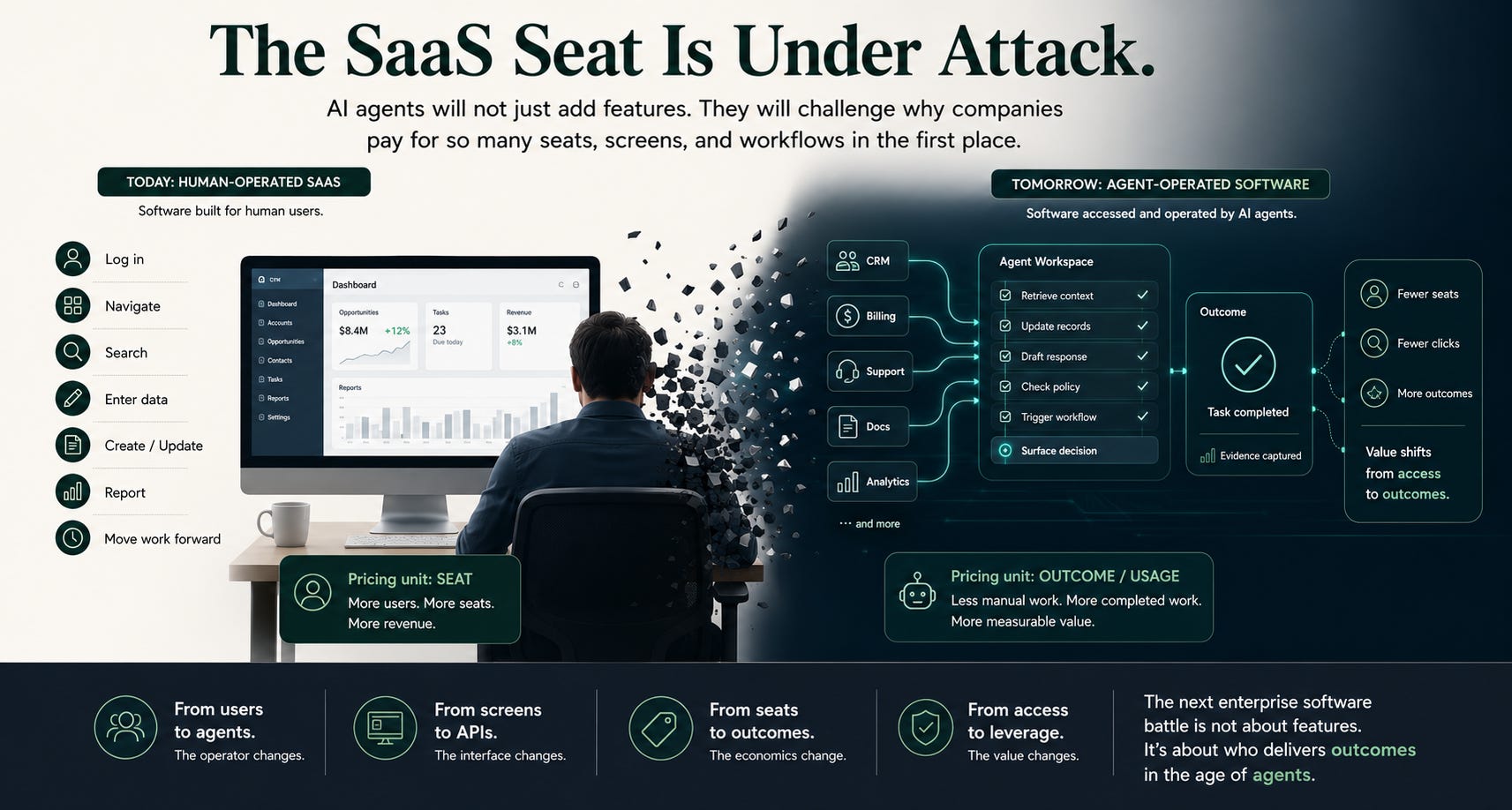
SaaS was built on a simple assumption:
Every workflow needs a human user.
More users meant more seats.
More seats meant more revenue.
More screens meant more product surface area.
More workflows meant more software spend.
The operating model was simple.
A company bought software.
Employees logged in.
They navigated dashboards.
They searched records.
They copied data.
They updated fields.
They created tasks.
They generated reports.
They moved work forward manually.
The software was the workplace.
AI agents challenge that assumption.
If an agent can read from CRM, update a ticket, draft a customer response, check a policy, pull billing context, trigger a workflow, and prepare the next action, then the question changes.
Not:
How many employees need access to this app?
But:
How many humans actually need to open the app every day?
That is the pressure coming for SaaS.
Not because enterprise apps disappear.
But because the economic logic behind many of them starts to change.
Gartner recently estimated that up to $234 billion in enterprise application software spend could be exposed to agentic AI disruption by 2030, representing roughly 20% of enterprise application SaaS spending. (Gartner)
That is not a small feature shift.
That is a business model warning.
The next AI disruption may not be model versus model.
It may be seat-based SaaS versus agent-operated software.
SaaS monetized human effort
The SaaS model made sense because humans had to operate the software.
A sales rep needed CRM access because they had to update opportunities, add notes, check account history, create follow-ups, and manage pipeline.
A support rep needed ticketing access because they had to read conversations, search knowledge bases, respond to customers, escalate issues, and close cases.
A finance analyst needed billing or ERP access because they had to review exceptions, verify invoices, check contracts, and approve payments.
A manager needed dashboards because they had to inspect performance, identify problems, and decide where to intervene.
Every human operator needed a seat.
The seat was not just a pricing unit.
It reflected how work happened.
Software stored the data.
Humans interpreted the data.
Humans clicked through the workflow.
Humans moved the state forward.
That is why SaaS products became full of dashboards, filters, forms, notifications, reports, permission layers, and workflow screens.
The product had to expose the work because humans had to perform the work.
AI agents weaken that assumption.
If the agent can perform the navigation, lookup, data entry, drafting, classification, routing, and preparation, the value of a full human seat becomes less obvious in some workflows.
The human may still matter.
But the human may not need to live inside the application.
They may only need to review exceptions, approve high-risk actions, or supervise outcomes.
That is a very different product and pricing model.
Agents turn apps into infrastructure
The app does not disappear.
The CRM still matters.
The ticketing system still matters.
The billing system still matters.
The HR system still matters.
The analytics system still matters.
The document repository still matters.
But the app’s role changes.
It becomes infrastructure for agents.
A system of record.
A permissioned data source.
A workflow backend.
An API surface.
A policy container.
An event stream.
A place where actions are recorded.
Humans may interact less with the app directly.
Agents may interact with it constantly.
That is the real shift.
Today, SaaS is designed for human operation.
Tomorrow, more SaaS will need to be designed for agent operation.
This means the most important product surface may not be the dashboard.
It may be the API.
The permission model.
The event log.
The audit trail.
The action approval layer.
The workflow state machine.
The data quality layer.
The integration surface.
Deloitte’s 2026 SaaS and AI agents outlook makes a similar point: as agentic AI becomes more common across SaaS platforms, how businesses purchase and use software could shift significantly, with software evolving toward more intelligent, personalized, adaptive, and autonomous workflow services. (Deloitte)
That is the future SaaS companies need to prepare for.
Not just better copilots inside the UI.
Agent-operable software underneath it.
The seat becomes less defensible
The SaaS seat is defensible when a human needs to be inside the app to create value.
But what happens when the agent does most of the routine work?
The agent logs activity.
The agent updates the record.
The agent drafts the reply.
The agent checks the policy.
The agent routes the ticket.
The agent prepares the approval.
The agent pulls the report.
The agent monitors the workflow.
The human reviews the important parts.
In that world, the buyer starts asking uncomfortable questions.
Why does every employee need a full seat?
Why are we paying for users who only approve work occasionally?
Why does this workflow require five apps open on a screen?
Why are we paying for software access instead of completed work?
Why are we buying dashboards when agents can surface the decision?
Why are we licensing seats for tasks that agents can perform through APIs?
This does not mean all seats vanish.
But it means some seat-based pricing will come under pressure.
Especially in workflow-heavy products where users spend much of their time moving data, checking records, copying information, updating statuses, creating reports, and routing tasks.
Those are exactly the activities agents are being built to absorb.
Bain has already argued that per-seat pricing is not dead, but AI is forcing software companies to rethink pricing models and experiment with new approaches. (Bain)
That is the transition we are entering.
Seat pricing may survive.
But it will not stay untouched.
The new buyer question
The old buyer question was:
How many seats do we need?
The new buyer question becomes:
How much work does this software complete?
That is a very different conversation.
Seat-based SaaS sells access.
Agent-operated software sells leverage.
The buyer will care less about how many people can log in and more about whether the software can help complete the workflow.
Can it reduce cycle time?
Can it lower cost per case?
Can it resolve more tickets?
Can it shorten audit preparation?
Can it reduce invoice exceptions?
Can it improve onboarding completion?
Can it reduce manual review?
Can it catch risk earlier?
Can it produce evidence?
Can agents access it safely?
Can humans approve the right actions?
The value unit shifts from user access to workflow outcome.
That is why AI agents are dangerous to traditional SaaS packaging.
They do not merely add another feature.
They change the unit of value.
The vulnerable SaaS pattern
Not every SaaS company is equally exposed.
Some software has deep systems-of-record value.
Some software owns regulated data.
Some software owns complex business logic.
Some software is deeply embedded in workflows.
Some software has strong network effects.
Some software remains essential for human judgment and collaboration.
But some products are more vulnerable.
The most exposed products tend to have a few traits.
They are seat-priced.
They depend on users manually entering or moving information.
They require repetitive navigation across screens.
They mostly coordinate workflows rather than own deep system-of-record value.
They make users copy, paste, search, classify, route, update, and report.
They charge for many users who only perform lightweight actions.
They have weak APIs or poor automation surfaces.
They are expensive relative to the value each user actually gets.
That is where agentic arbitrage becomes real.
A company may not remove the system.
But it may reduce the number of people who need to use it directly.
The system remains.
The seats shrink.
The human interface moves elsewhere.
The agent becomes the operator.
The winning SaaS pattern
The winners will not simply add “AI assistant” to the sidebar.
That may help, but it is not enough.
The winning SaaS companies will make their platforms agent-operable.
That means:
Clean APIs.
Granular permissions.
Action-level authorization.
Reliable event streams.
Strong data models.
Audit trails.
Human approval flows.
Clear rollback paths.
Usage-based value metrics.
Native agent orchestration.
Policy-aware automation.
The best SaaS products will not fight agents.
They will become the safest and most useful tool layer for them.
They will let agents read the right context, take the right actions, surface the right evidence, and stay within the right boundaries.
That is where defensibility moves.
Not just:
We have the best dashboard.
But:
We are the system agents trust to complete this workflow safely.
This is why SaaS companies need to think beyond copilots.
A copilot helps humans operate the app.
An agent-ready platform lets software operate the workflow.
Those are not the same thing.
Copilots protect the seat. Agents question the seat.
A copilot improves the existing SaaS model.
It helps the user write faster, search faster, summarize faster, analyze faster, or complete forms faster.
That is useful.
But it still assumes the human is inside the app.
The human remains the operator.
The copilot makes the operator more productive.
Agents create a different possibility.
The agent may operate across apps without the human opening each one.
It may gather context from CRM, billing, support, analytics, contracts, docs, email, and Slack.
It may prepare the action before the human even logs in.
It may only ask for approval when risk crosses a threshold.
That means the UI shifts.
The human no longer needs every operational screen.
The human needs an outcome surface.
Approve.
Edit.
Reject.
Escalate.
Investigate.
Override.
This is why agents are more disruptive than copilots.
Copilots make SaaS seats more valuable.
Agents may make some seats less necessary.
The pricing model has to change
If AI changes how software is used, pricing has to follow.
The old model was simple:
Pay per user.
The emerging model will be messier.
Some pricing may remain seat-based.
Some may become usage-based.
Some may become outcome-based.
Some may charge per workflow.
Some may charge per agent action.
Some may charge based on automation volume.
Some may combine platform fees, seats, and consumption.
Microsoft’s reported shift toward a “per-seat plus consumption” model for Copilot shows how major software companies are already experimenting with hybrid pricing structures around AI usage. (MarketWatch)
This makes sense.
AI changes the cost structure.
It also changes the value structure.
A human seat is predictable.
Agent usage is variable.
One workflow may require one model call.
Another may require retrieval, tool calls, validation, retries, approval, and audit logging.
The vendor has cost exposure.
The customer wants value clarity.
That tension will reshape SaaS pricing.
The question becomes:
What should the customer pay for?
Access?
Usage?
Completed work?
Risk reduction?
Time saved?
Revenue protected?
Cases resolved?
Actions approved?
The SaaS companies that answer this well will grow with the agent era.
The ones that cling too tightly to seat expansion may face pressure from customers who see agents doing the work humans used to do manually.
The buyer will ask for agent access
Enterprise procurement will change too.
Today, buyers ask:
How many seats?
Which edition?
Which modules?
Which integrations?
What admin controls?
What reporting?
What security certifications?
Tomorrow, they will also ask:
Can our agents access this system?
Can agents read and write safely?
Can we limit actions by workflow?
Can we approve high-risk changes?
Can we track every agent action?
Can we separate human actions from agent actions?
Can we meter agent usage?
Can we revoke agent access instantly?
Can we audit what the agent saw and changed?
Can we connect this system to our enterprise agent layer?
That last question matters.
The buyer may not want every SaaS vendor to own the agent experience.
They may want their own agents to operate across multiple systems.
That creates a new battle.
Will the SaaS vendor own the agent?
Will the enterprise own the agent?
Will a platform layer own the orchestration?
Will the SaaS app become one tool among many?
This is where enterprise software strategy gets interesting.
The vendor wants to keep the user inside its product.
The enterprise wants agents that work across products.
Those incentives may collide.
SaaS companies will face agentic arbitrage
Agentic arbitrage means customers may use agents to get the value of software without paying for as many traditional seats or without using the product in the way the vendor expected.
The app still stores data.
The app still runs the workflow.
The app still matters.
But the human usage pattern changes.
Fewer people log in.
More work happens through agents.
More interactions happen through APIs.
More decisions happen in external approval layers.
More value is captured outside the vendor’s UI.
This is the risk Gartner is pointing at when it says a large portion of enterprise application SaaS spend could be exposed to agentic AI disruption. (Gartner)
For SaaS companies, this raises a strategic question.
Do you defend the seat?
Or do you embrace the agent?
Defending the seat may protect revenue short term.
But embracing the agent may protect relevance long term.
The worst position is to have software that agents need to access, but customers feel the pricing model punishes them for using it efficiently.
That creates room for new entrants.
New entrants will sell the workflow, not the seat
The next wave of AI-native enterprise companies may not look like traditional SaaS.
They may not start with dashboards.
They may start with a workflow outcome.
Resolve invoice exceptions.
Prepare audit evidence.
Triage incidents.
Handle procurement intake.
Review claims.
Qualify leads.
Draft RFP responses.
Manage renewals.
Reduce support escalations.
These products may use existing SaaS apps as tools.
CRM is a tool.
Ticketing is a tool.
ERP is a tool.
Document storage is a tool.
Email is a tool.
Calendar is a tool.
The AI-native product owns the workflow layer across them.
That is dangerous for incumbents.
Because the workflow layer is where the buyer feels value.
If the AI-native product reduces cost, cycle time, and manual effort, the buyer may care less about where the underlying data lives.
The incumbent becomes infrastructure.
The agent-native company owns the outcome.
That is how value shifts.
The dashboard is no longer the moat
For years, SaaS companies competed on product experience.
Better dashboards.
Cleaner workflows.
More intuitive navigation.
Better reporting.
More collaboration features.
These still matter.
But in an agent-operated world, the dashboard becomes less central.
Agents do not care whether the dashboard looks beautiful.
They care whether the system is accessible, reliable, permissioned, observable, and action-ready.
Can the agent retrieve the correct object?
Can it understand the data model?
Can it make a safe update?
Can it trigger a workflow?
Can it attach evidence?
Can it respect approvals?
Can it write back cleanly?
Can it create an audit trail?
The moat shifts from UI elegance to operational trust.
A beautiful UI with weak APIs becomes less valuable.
A strong system of record with safe agent access becomes more valuable.
This does not mean design stops mattering.
It means the primary user may no longer always be human.
Sometimes the primary operator will be an agent.
Software needs to be designed for both.
The human does not disappear
The agent-operated SaaS story is not a story where humans vanish.
It is a story where humans move up the workflow.
Less manual navigation.
Less copy-paste.
Less routine updating.
Less searching across systems.
More supervision.
More approval.
More exception handling.
More judgment.
More policy design.
More outcome ownership.
That is the better version.
The bad version is different.
Agents create messy updates.
Humans check everything.
Costs rise.
Seat pricing stays high.
The workflow gets more complicated.
No one can tell whether value improved.
That is why SaaS companies and buyers need to be careful.
Agent-operated software only works when there is trust, evidence, permissioning, and measurable outcomes.
Otherwise, it becomes automation theater.
What SaaS leaders should do now
SaaS leaders should ask a direct question:
If agents become the main operators of our product, what breaks?
Pricing?
Permissions?
APIs?
Data model?
Audit trail?
Workflow design?
Usage metrics?
Customer success motion?
Product analytics?
Packaging?
That question is uncomfortable, but necessary.
The companies that adapt early will build for the agent era.
They will create agent access tiers.
They will expose safe action APIs.
They will build approval infrastructure.
They will price around usage and outcomes.
They will make workflows observable.
They will help customers measure value.
They will treat agents as first-class users.
The companies that do not adapt may discover that their product is still important, but their seat model is less defensible.
That is the threat.
Not death.
Compression.
The software remains.
The seat count changes.
The value layer moves.
What buyers should do now
Enterprise buyers should also prepare.
Do not only ask whether a SaaS vendor has AI features.
Ask whether the software is ready for agentic operation.
Can agents access it safely?
Can permissions be scoped to actions?
Can usage be audited?
Can agent-driven changes be separated from human changes?
Can approvals be embedded?
Can costs be measured?
Can workflows be triggered externally?
Can the system support outcome-based measurement?
Also ask a harder question:
Which seats exist because people need judgment, and which seats exist because people are forced to operate software manually?
That distinction matters.
The first category may remain.
The second category is exposed.
If a person is mostly logging in to search, copy, paste, update, route, and report, an agent may eventually absorb much of that work.
The buyer should not just count seats.
The buyer should map work.
Final thought
AI agents will not just change how we use software.
They will change why we buy it.
For two decades, SaaS grew by putting more humans inside more applications.
More seats.
More screens.
More workflows.
More dashboards.
More software spend.
The agent era challenges that logic.
If software can be operated by agents, then the buyer will start asking for fewer clicks, fewer seats, and more completed work.
The winners will not simply be the apps with the best UI.
They will be the systems agents can trust, enterprises can govern, and buyers can measure.
The next enterprise software battle is not only about who adds AI fastest.
It is about who survives the shift from selling access to delivering outcomes.
The SaaS seat is under attack.
And this time, the attacker is not another SaaS app.
It is the agent operating across all of them.
Discussion prompt
Where do you think agentic AI pressures SaaS pricing first: CRM, support, finance operations, HR, procurement, analytics, project management, or compliance software?
This is a sharp articulation of something I've been thinking about from the builder side. The distinction you draw between "defending the seat" and "embracing the agent" is the right frame — most of the current AI-in-SaaS conversation stays stuck in the copilot layer and skips the harder question you're asking: what does it take for a system to actually trust an agent to act?
I've spent the last year and a half building a governance layer for exactly this problem in regulated sectors (healthcare, AEC) — the piece that sits between an agent and the system of record: action-level authorization, a tamper-evident audit trail, and a human-in-the-loop approval step for anything high-risk. Reading this, it's validating to see the market-level argument for why that layer matters, articulated so clearly from the buyer side.
Curious how you see the audit/approval layer playing out competitively — do you think incumbents build it in-house, or does it become its own category that plugs into existing SaaS?