
When Agent Graphs Hit Production
Directed graphs look clean in demos. Long-running agent systems need events, state streams, retries, and recovery.

The first version of an agent workflow usually looks like a graph.
A user request enters Node A. The router sends it to Node B. A supervisor checks the output. If the condition passes, the workflow moves to Node C. If not, it loops back for another attempt.
On a slide, this looks clean.
In production, the graph starts absorbing everything the slide ignored: API timeouts, partial tool responses, stale context, model changes, token spikes, retries, human approvals, and long-running state.
That is where directed graphs become fragile.
Not because graphs are useless.
They are useful for bounded workflows: short tasks, clear branches, predictable tools, and controlled state.
But enterprise agent systems are often not bounded. They are distributed, asynchronous, stateful, and failure-prone. They do not always move cleanly from one node to the next. They wait for tools. They retry. They pause for approval. They react to external systems. They recover from partial failure.
At that point, the better question is not:
What node comes next?
It is:
What event happened, who should react, and how do we recover if one agent fails?
That is the shift from graph orchestration to Event-Driven Agentic Architecture.
Where agent graphs break
In many multi-agent systems, communication still depends on tightly coupled, request-response orchestration.
Agent A calls Agent B.
Agent B waits for a tool.
Agent C depends on Agent B’s output.
A supervisor watches the chain.
The workflow continues only if every step returns the expected shape.
This works well enough in demos.
It becomes harder when the workflow is long-running, parallel, or dependent on external systems.
A small upstream API change can break a downstream parser. A tool timeout can leave the workflow in an uncertain state. A prompt or model version change can cause the router to miss a condition that worked last week. A token spike can push one step over the limit and leave the graph waiting on a node that never completes.
The issue is not that directed graphs are wrong.
The issue is that tightly coupled graphs treat the agent workflow like a monolithic script, while production agents behave more like distributed systems.
That creates three common failure modes.
First, synchronous latency compounds. If one agent waits on another agent, which waits on another tool call, the entire user-facing workflow can become blocked behind a chain of reasoning steps and API calls.
Second, recovery becomes complicated. If an agent fails halfway through a graph, the system has to reconstruct the exact state of the workflow: what was retrieved, what was mutated, what was approved, what was retried, and what should happen next.
Third, adding new capabilities becomes expensive. A new audit agent, compliance agent, or notification agent may require new conditional edges, new supervisor logic, and new state transitions across the graph.
The more agents you add, the more the graph becomes a coordination bottleneck.
From orchestration to choreography
Event-driven architecture changes the model.
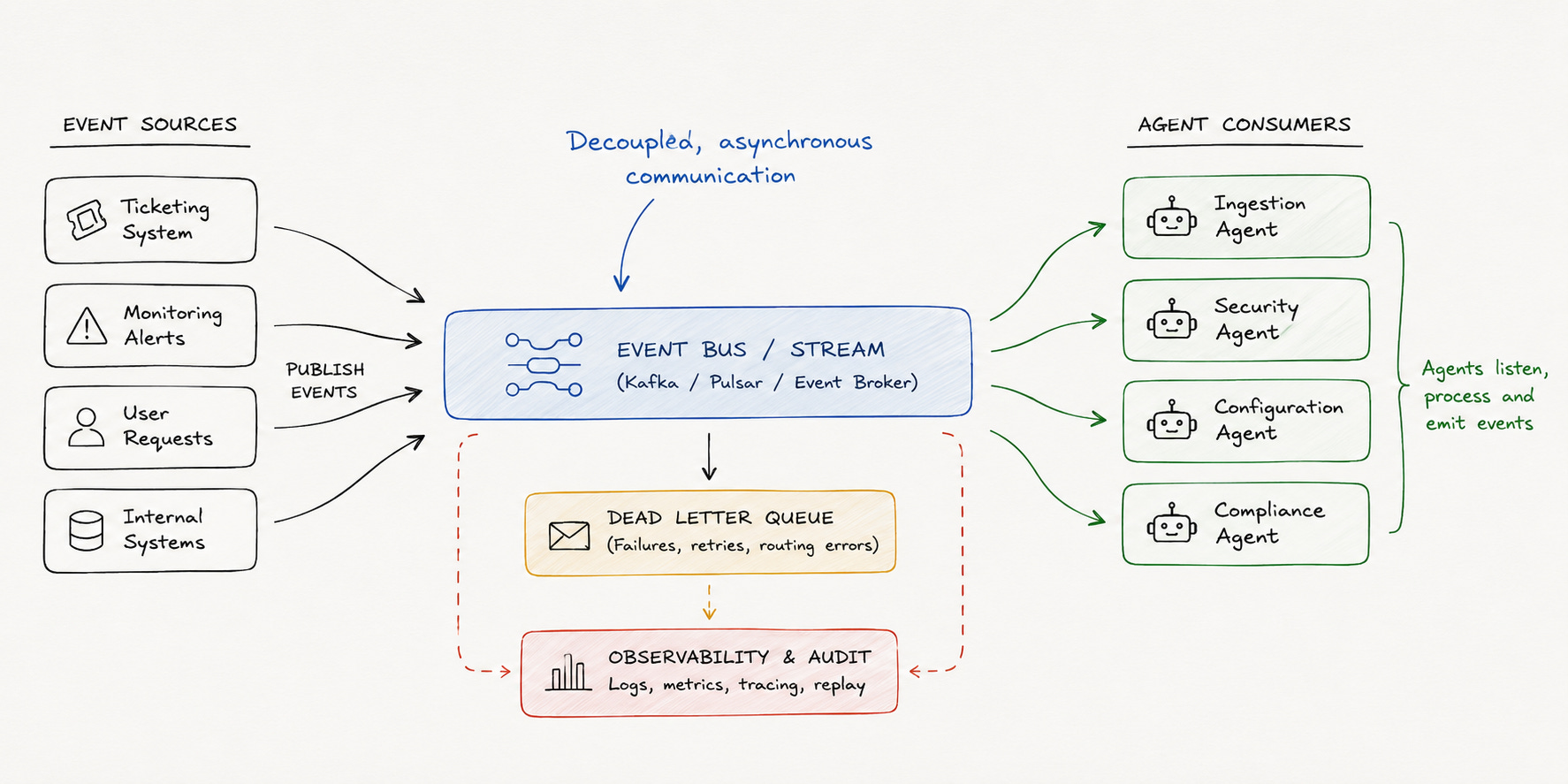
Instead of one central controller telling every agent what to do, independent agents react to events.
The system stops thinking in terms of direct handoffs:
Controller → Agent A → Agent B → Agent C
And starts thinking in terms of facts emitted into a shared event stream:
Agent A emits: ticket.context_enriched
Agent B listens and evaluates risk
Agent C listens and drafts configuration
Agent D listens and checks compliance
This is choreography instead of orchestration.
Each agent does not need to know every other agent. It only needs to know which events it cares about, what it should do when it receives one, and what event it should emit next.
A simplified event-driven workflow might look like this:
workspace.provisioned
        ↓
onboarding.context_enriched
        ↓
security.risk_evaluated
configuration.plan_drafted
compliance.check_started
        ↓
approval.required
        ↓
onboarding.ready_for_human_review
The important difference is that these agents can work independently.
If the Security Agent times out, the Configuration Agent does not need to freeze. The event can be retried, delayed, routed to a dead-letter queue, or replayed later. The system keeps its state in the stream, not hidden inside a brittle graph execution.
That is the architectural advantage.
Graphs coordinate steps.
Events coordinate systems.
The enterprise onboarding example
Take a customer onboarding workflow.
In a graph-based design, you might wire the workflow like this:
Provision Workspace → Enrich Context → Security Review → Configuration → Approval → Welcome Email
That looks fine until production adds complexity.
Security review may require external vendor data. Configuration may depend on contract tier. Compliance may need to check regional rules. Customer success may need to approve the onboarding plan. Some steps can run in parallel. Some may pause for hours. Some may fail and need retries. Some may need human approval before proceeding.
A rigid graph starts to feel awkward because the real workflow is not just a sequence.
It is a stream of state changes.
In an event-driven design, the workflow becomes more flexible.
The upstream system emits:
workspace.provisioned
An Ingestion Agent consumes the event, enriches the customer profile, and emits:
onboarding.context_enriched
Now multiple agents can react in parallel.
The Security Agent checks risk boundaries.
The Configuration Agent drafts setup recommendations.
The Compliance Agent checks regional constraints.
The Customer Success Agent prepares the onboarding brief.
None of them needs to directly call the others.
They publish facts back to the stream.
That makes the system easier to extend. If you want to add a Billing Agent later, it can subscribe to the relevant events without rewiring every edge in the original workflow.
This is why event-driven design matters for growing agent systems.
It lets the architecture evolve without turning every new agent into a graph surgery project.
Stop paying the polling tax
There is another practical benefit: event-driven agents do not need to constantly ask whether work exists.
In many custom agent setups, background workers poll folders, databases, ticket queues, inboxes, or APIs to check whether something changed.
Most of the time, nothing has changed.
The agent wakes up, checks, finds no relevant work, and goes back to sleep.
That creates unnecessary compute, orchestration overhead, and sometimes unnecessary model context preparation.
Event-driven agents work differently.
They remain inactive until a relevant event arrives.
A support agent does not need to poll the ticketing system every few minutes. It can react to:
ticket.created
ticket.reopened
ticket.escalated
An incident triage agent does not need to keep asking whether alerts exist. It can react to:
alert.triggered
incident.updated
runbook.changed
A compliance evidence agent does not need to scan everything constantly. It can react to:
control.review_requested
evidence.expired
policy.updated
This does not mean event infrastructure has no cost.
It means the agent runtime does not need to perform model-driven work until something relevant happens.
That is the right default for many enterprise workflows.
Agents should listen, react, emit, and sleep.
Event sourcing for agent debugging
Debugging an agent graph can be painful.
The final answer is wrong, but the cause could be anywhere.
Was the retrieved document stale?
Did the router choose the wrong branch?
Did the tool return partial data?
Did the supervisor approve the wrong step?
Did memory inject the wrong context?
Did a policy check fail silently?
If the system only stores the final output and a few logs, the team has to reconstruct the run by guesswork.
Event-driven systems make a better debugging model possible.
Every meaningful transition can be written to an append-only event log:
user request
retrieved source IDs
tool inputs
tool outputs
policy checks
approval decisions
model version
prompt version
agent output
action result
error states
retry attempts
That gives teams a replayable history of the workflow.
If the agent fails at 3:00 a.m., engineers can inspect the event stream before the failure, replay the sequence in a local environment, and see which event caused the system to diverge.
This is event sourcing applied to agent systems.
The goal is not to log private chain-of-thought.
The goal is to capture enough operational evidence to answer:
What did the agent see, what did it call, what did the system allow, and what changed?
That is the difference between debugging a transcript and debugging a production system.
The dead-letter queue becomes part of the agent architecture
In graph-based systems, failures often show up as broken nodes, stalled executions, or corrupted state.
In event-driven systems, failures can be routed.
If an agent receives an event it cannot parse, the system can send it to a dead-letter queue. If a tool times out, the event can be retried with backoff. If a schema validation fails, the event can be parked for inspection. If a policy check blocks the action, the blocked event can be logged and escalated.
That failure handling becomes part of the architecture.
For example:
agent.commands.refund_requested
        ↓
policy.check_failed
        ↓
agent.dlq.refund_blocked
        ↓
human.review_required
This is cleaner than forcing the graph to keep track of every possible failure branch.
It also makes operations easier.
Teams can monitor which event types fail most often, which agents produce invalid payloads, which tools timeout, and which workflows repeatedly hit approval or policy blocks.
That is how agent systems become observable.
Not by hoping every graph run completes.
By making every state transition visible.
When graphs still make sense
This is important: event-driven architecture is not a universal replacement for graph orchestration.
Graphs still make sense when the task is short-lived, bounded, and mostly deterministic.
A document summarization workflow may be fine as a graph.
A simple research-and-draft workflow may be fine as a graph.
A constrained support triage flow may be fine as a graph.
A narrow tool-use sequence may be easier to reason about as a graph.
The problem starts when the workflow becomes long-running, parallel, failure-prone, or dependent on multiple external systems.
That is the line.
Use graphs when you are coordinating a bounded reasoning flow.
Use events when you are coordinating a distributed operating system.
Most serious enterprise agent systems will likely use both.
A local agent may use a graph internally to reason through a task.
The broader system should use events to coordinate agents, tools, approvals, retries, and state transitions.
That hybrid model is probably the practical future.
Graphs inside agents.
Events between agents.
The architecture mandate
Once an agentic stack moves past simple text generation and starts handling long-running workflows, mutating records, reacting to external systems, and coordinating multiple agents, state cannot live only inside a graph execution.
It needs to be externalized.
The system needs durable events, consistent schemas, replayable state, dead-letter queues, retries, observability, and audit trails.
That is the production shift.
Stop thinking of agents as fragile nodes inside one giant flowchart.
Think of them as independent runtimes reacting to a shared stream of facts.
They listen.
They reason.
They emit.
They sleep.
They recover.
That is the foundation of Event-Driven Agentic Architecture.
Event-Driven Agentic Routing Specification
For subscribers, I’m sharing an Event-Driven Agentic Routing Specification.
Use it as a starting point for designing decoupled, replayable multi-agent workflows.
It includes:
CloudEvent-style agent envelope
topic hierarchy blueprint
choreography state matrix
dead-letter queue runbook
retry and escalation logic
audit and trace fields
Simple rule:
If your agent workflow is long-running, parallel, and failure-prone, do not hide state inside the graph. Put the state transitions on the stream.
Launch Gate
Before moving a graph-based agent workflow to an event-driven architecture, define:
AreaQuestionEvent envelopeDo all agent events share a consistent schema?Topic hierarchyAre ingestion, context, command, policy, and exception events separated?IdempotencyCan consumers safely process duplicate events?Retry policyWhich failures are safe to retry?DLQ routingWhere do failed events go?ReplayCan the workflow be replayed from a known event offset?AuditCan you reconstruct what the agent saw, requested, and changed?ApprovalAre high-impact actions routed through approval events?OwnershipWho owns each event type and failure mode?
Final rule:
If the system cannot replay the workflow, inspect failed events, and recover safely, it is not ready for long-running agentic production workflows.
Community discussion
Where are you seeing agent graphs break first: retries, state recovery, tool failures, conditional routing, human approvals, or debugging?
Ashu, ran your Launch Gate against a governance system I've been building for AI in AEC (construction) and got a mixed result, in a good way.
I've got idempotency covered with operation_id on every write, a priority DLQ with retry and escalation, and fencing tokens to stop concurrent writes from corrupting shared state. What I haven't solved yet is event taxonomy, my categories overlap (ingestion, context, command, policy and exception aren't cleanly split the way your piece describes). And replay from an operation_id isn't faithful yet either, since I'm not capturing model and prompt version in the event envelope, which your piece flags as a hard requirement.
Fixing both before I touch anything new. Curious if in your experience taxonomy drift or broken replay tends to be the first thing that cracks once these systems hit real production load.
The example failures sound more like a sequential handoff between agents. Is that what you call Orchestration? Orchestration definitely includes monitoring the execution of work and coordination between members involved. If these are not done, it is not orchestration to begin with.