
Your AI Agents Need a Control Plane, Not Another Framework
The next enterprise AI failure will not come from a bad prompt. It will come from autonomous runtimes with no registry, no budget, no policy enforcement, and no kill switch.

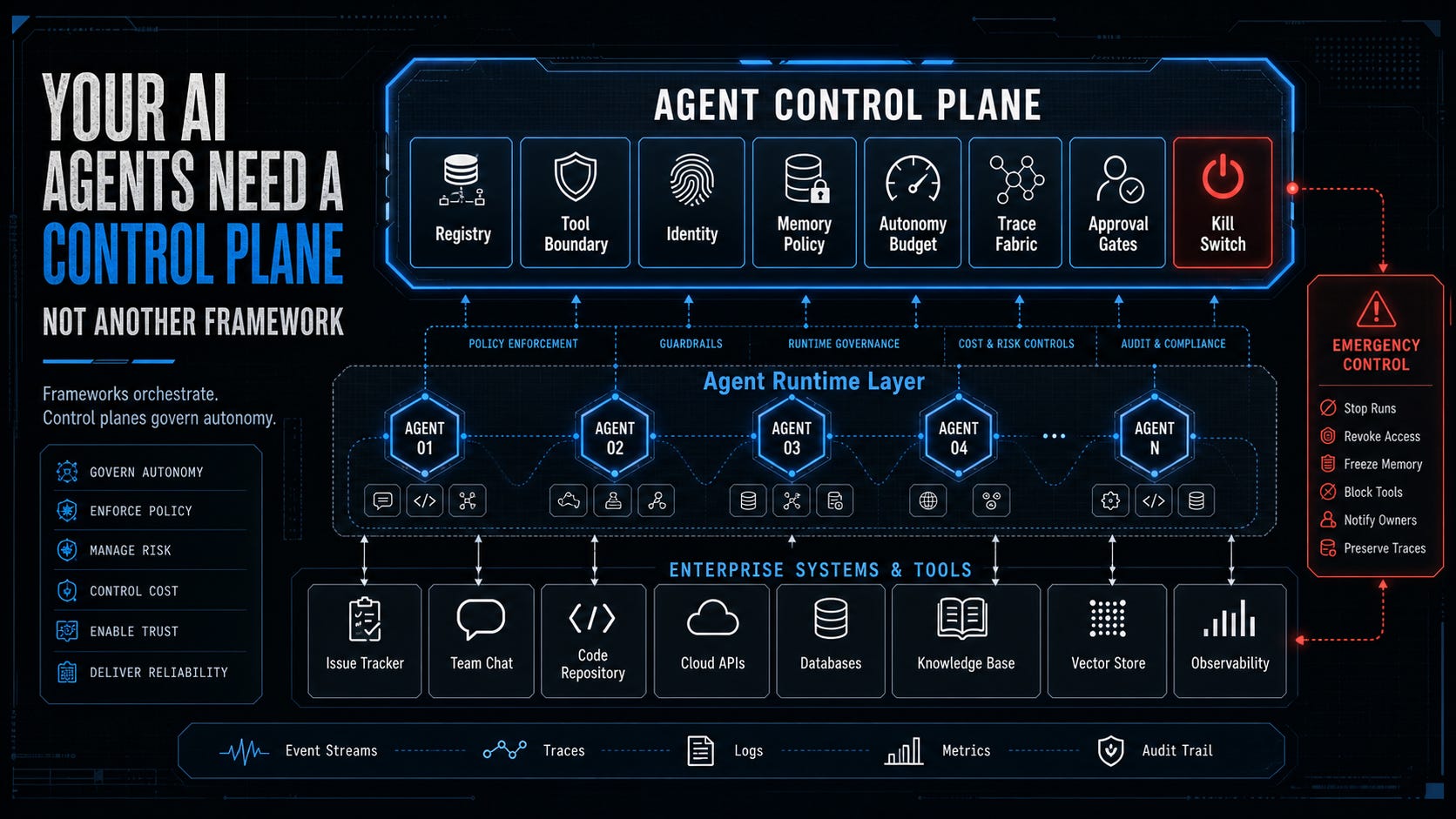
The next enterprise AI failure will not look like a chatbot giving a weird answer.
It will look like this: A product team ships an internal AI agent that can create Jira tickets, summarize Slack threads, open GitHub pull requests, query internal docs, and call a few cloud APIs.
At first, it looks useful. Then another team connects a similar agent to customer support tooling. Then platform engineering gives a coding agent access to deployment logs. Then finance pilots an agent that can read vendor contracts.
Then security discovers that nobody can answer five basic questions:
Which agents are running?
Who owns them?
Which tools can they touch?
How much can they spend?
How do we shut one down without breaking the workflow around it?
That is the moment the prototype becomes an architecture problem. Not a prompting problem. Not a model-selection problem. Not a “we should try a different framework” problem.
It is a control-plane problem.
Agent frameworks help you build agents. They help you define graphs, tasks, tools, memory, handoffs, retries, and orchestration logic. That matters. But orchestration is not governance.
An agent framework decides how an agent does work. An agent control plane decides whether that work should be allowed to happen at all. And most enterprises are still confusing the two.
The Framework Trap
The current agent conversation is stuck at the construction layer. Teams ask:
Should we use LangGraph, CrewAI, AutoGen, Semantic Kernel, or the OpenAI Agents SDK?
Should the agent use MCP tools?
Should the workflow be a graph, a planner, a swarm, or a router?
Should memory live in a vector database, relational store, graph, or cache?
These are valid engineering questions. But they are not the questions that decide whether agents survive production. Production asks a different set of questions:
Can this agent call payroll APIs?
Can it write to the customer database?
Can it remember sensitive information?
Can it delegate work to another agent?
Can it retry a failed tool call forever?
Can it spend $400 on inference before anybody notices?
Can it make a change that requires approval?
Can we reconstruct exactly what happened after the incident?
The framework does not own all of that. Your platform does. Your security boundary does. Your observability system does. Your identity layer does. Your workflow engine does. Your policy engine does. Your cost controls do. Your incident-response process does.
And that is the problem. The control surface is scattered across too many systems.
Agents create governance sprawl because they do not fit cleanly into the old boxes. They are not just applications. They are not just API clients. They are not just background workers. They are not just users.
They are autonomous runtimes that can reason, choose tools, mutate state, store memory, escalate work, and create second-order effects across systems. Treat them like normal apps and they will escape the boundaries normal apps were designed for.
The Market Is Already Moving Here
This is not a theoretical category anymore:
IBM now describes an agent control plane as the system that deploys, operates, monitors, and governs AI agents across an organization.
Microsoft Foundry Agent Service is packaging enterprise agent deployment around tools, publishing, versioning, and production infrastructure.
LangSmith uses control-plane and data-plane language for managing agent deployments, revisions, listeners, monitoring, and tracing.
OpenTelemetry has development-stage semantic conventions for GenAI agent and framework spans, including agent invocation, workflow invocation, and tool execution.
OWASP is already documenting MCP-specific risks because tool and context access create a new enterprise attack surface.
The signal is clear: The industry is moving from “How do I build an agent?” to “How do I govern a fleet of agents?”
But the enterprise architecture is still missing a practical mental model. So here is the one I would use.
The Agent Control Plane
An Agent Control Plane is the runtime governance layer that sits above individual agents and below enterprise systems of record.
It does not replace your agent framework. It constrains it.
It does not replace IAM. It gives agents a usable identity boundary.
It does not replace observability. It makes agent behavior traceable as first-class runtime activity.
It does not replace human approval. It decides when human approval is mandatory.
The control plane exists because an agent’s real risk is not the text it generates. The risk is the action it takes after generating the text. The enterprise control plane needs seven operating layers, plus one non-negotiable emergency control.
1. The Agent Registry
If you cannot list your agents, you cannot govern them. Every production agent needs a registry entry. Not a README. Not a Slack announcement. Not a line item buried inside a team’s sprint board. A registry.
At minimum, the registry should answer:
What is the agent’s mission?
Who owns it?
Which business process does it support?
Which model or model family does it use?
Which tools can it request?
Which memory stores can it read or write?
Which environments can it run in?
What is its autonomy level?
What is its rollback or shutdown path?
This is the first place most enterprises fail. They inventory APIs, cloud resources, and containers. But they do not inventory agents. That worked when agents were experiments. It will fail when agents become production workers.
2. The Tool Boundary
The most dangerous sentence in agent architecture is: “We gave it access to the tools it needs.”
That sounds reasonable. It is also how governance sprawl begins. A tool is not just a function call. A tool is a delegated action boundary. If an agent can call a tool, the agent has inherited some slice of the authority behind that tool.
Every tool exposed to an agent needs a contract:
What can the tool do?
What can it never do?
What input shape is allowed?
What output shape is trusted?
What data classes can pass through it?
What rate limit applies?
What approval gate is required?
What audit event is emitted?
This is the Tool Boundary. Without it, the agent is not using tools. It is borrowing permissions from whatever engineer wired the tool into the demo. That is not architecture. That is liability with a friendly tone.
3. Identity, Secrets, and Delegated Authority
Agents should not run with developer keys. They should not inherit broad service-account privileges. They should not impersonate a human user unless the boundary is explicit, logged, and revocable.
An enterprise agent needs its own identity model. The key question is not “Can the agent authenticate?” The key question is: “What authority is the agent allowed to exercise, on whose behalf, for how long, and under what policy?”
That means agents need scoped credentials, short-lived tokens, delegated authorization, and per-tool permission envelopes. The identity layer should make it possible to say:
This agent can read tickets, but cannot close them.
This agent can draft a pull request, but cannot merge it.
This agent can summarize a contract, but cannot send it outside the company.
This agent can query production logs, but cannot retrieve customer PII.
This agent can propose a cloud change, but cannot execute it without approval.
If the agent has a “god token,” your control plane has already failed.
4. The Memory Policy
Memory is not a feature. Memory is a data-governance surface. The more your agent remembers, the more your organization must explain:
Why was this stored?
Where was it stored?
Who can retrieve it?
How long does it live?
Can it be deleted?
Can it leak into future reasoning?
Can another agent consume it?
Bad memory makes agents confidently wrong. Uncontrolled memory makes them unsafe. The control plane needs a memory policy that separates:
Working memory: what the agent needs during the current task.
Session memory: what the agent can carry across one workflow.
Durable memory: what can persist beyond the workflow.
Shared memory: what other agents are allowed to consume.
Forbidden memory: what must never be stored.
This is where many “personalized agent” strategies become enterprise risk. The agent is not just learning. It is accumulating state. And accumulated state without policy becomes context debt.
5. The Autonomy Budget
Every production agent needs a budget. Not just a dollar budget. An autonomy budget. An Autonomy Budget defines how much independent action an agent can take before a human, policy engine, or supervisor must intervene.
It includes:
Token budget
Tool-call budget
Retry budget
Time budget
Spend budget
Scope budget
Risk budget
This prevents the classic runaway-agent failure mode: The agent fails a tool call. Then retries. Then asks another tool for context. Then expands the search. Then summarizes the wrong thing. Then calls another agent. Then burns tokens explaining its own confusion. Then opens a ticket. Then someone discovers the agent spent money, mutated state, and created operational noise without producing a useful outcome.
The fix is not a better prompt. The fix is a runtime budget. An agent should know when it is allowed to continue, when it must degrade, when it must ask, and when it must stop.
6. The Trace Fabric
Traditional observability tells you what a service did. Agent observability must tell you why the runtime believed an action was appropriate. You need traces that connect:
User request
Agent identity
Model invocation
Retrieved context
Memory reads and writes
Tool selection
Tool execution
Policy decision
Human approval
Final action
Cost and latency
Error path
This is the Trace Fabric. Not a pile of logs. Not screenshots of prompts. Not a dashboard that says “agent success rate.” It is a traceable chain of reasoning-adjacent runtime events.
The goal is to reconstruct the production path: What did the agent know? What did it decide to call? What system changed? Who approved it? If you cannot answer those questions after an incident, you do not have agent observability. You have agent archaeology.
7. Human Approval Gates
Human-in-the-loop is usually discussed as a UX feature. That framing is too soft. In production architecture, approval is a control boundary.
The question is not: “Should a human review this?”
The question is: “Which actions are structurally impossible without human approval?”
Approval gates should be attached to risk classes, not vibes:
Low risk: summarize, classify, draft, retrieve.
Medium risk: create ticket, prepare pull request, recommend config.
High risk: send external message, update record, trigger workflow.
Critical risk: deploy, delete, transfer money, modify access, touch regulated data.
The control plane should make critical actions unavailable without approval. Each escalation should carry context, diff, blast radius, and rollback path. Otherwise “human-in-the-loop” becomes theater.
The Mandatory Emergency Control: Runtime Kill Switch
Every agent needs a stop mechanism. Not a polite instruction in the system prompt. A runtime kill switch.
The kill switch must be able to:
Stop the current run.
Revoke tool access.
Freeze memory writes.
Prevent retries.
Block downstream agent delegation.
Preserve traces for incident review.
Notify the owner.
Put the workflow into a known safe state.
Normal software usually fails by throwing an error or timing out. Agents can fail by continuing. They can continue with bad assumptions, stale context, or partial authority. The control plane needs the power to stop the runtime, not just observe it.
Why Existing Enterprise Controls Are Not Enough
At this point, the obvious objection is: “Don’t we already have this?”
Sort of. But not in one control surface.
API gateways control API traffic. They do not understand agent autonomy.
IAM controls identity and permissions. It does not understand reasoning paths, tool selection, or retry loops.
Observability platforms collect telemetry. They do not decide whether an agent should be allowed to call the next tool.
Workflow engines coordinate steps. They do not always understand probabilistic decision-making.
Agent frameworks orchestrate behavior. They do not become the enterprise governance layer just because they can call tools.
Security scanners find known weaknesses. They do not own the runtime boundary between model output and business action.
That is why the control plane matters. It is not another dashboard. It is the missing runtime contract between autonomous agents and enterprise systems.
The Architecture Shift
The first generation of enterprise AI asked: “Which model should we use?”
The second generation asked: “Which agent framework should we use?”
The next generation will ask: “What is our agent control plane?”
Because once agents start operating across real business systems, the framework decision becomes only one part of the stack. The more important question is: Who governs the autonomy?
That governance cannot live inside a prompt. It cannot live inside one app team. It cannot live inside a vendor demo. It needs to be a first-class architecture layer.
If you are a CTO, VP of Engineering, platform leader, or enterprise architect, do not let agents touch production systems until you can answer:
Where are they registered?
Which tools are inside their boundary?
What identity do they use?
What memory can they keep?
What autonomy budget constrains them?
What trace fabric explains them?
What approval gates stop them?
What kill switch terminates them?
If the answer is “the framework handles that,” look again. The framework may help. But your framework is not your control plane.
This resonates a lot. The part I think is still under-discussed is that control planes are not just an engineering layer, they are a responsibility layer. Once agents can act across tools, the real question becomes: what are they allowed to touch, what are they allowed to break, and who owns the judgment when the system behaves correctly but in the wrong direction?
Ashu, a strong framework and matches what we find building for regulated sectors.
An addition to the field, the tracking layer becomes even more critical when agents operate in legally responsible contexts. Standard observability (what happened) is not enough because you need a chain of custody, which captures why the runtime believed an action was justified, with the normative or evidentiary references sealed at the time of generation. Without this, human-in-the-loop, it remains theater, as you say, because approval without verifiable justification does not stand up to scrutiny.
The distinction between an agent control plane and an agent framework is exactly the right conversation to have in 2026. Most teams are still confusing the two. It would be a huge honor to present my project to you.